Forgot What Was Injected Years Ago? How Ultrasound Identifies Unknown Filler Materials
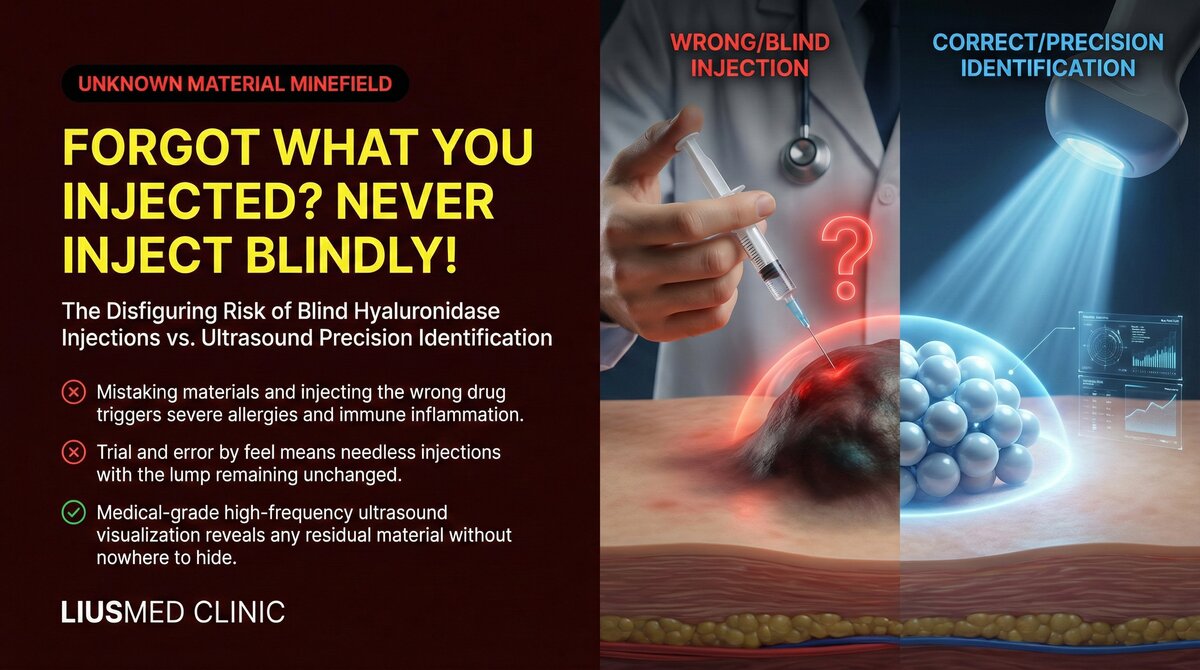
"I Honestly Cannot Remember What Was Injected"
This is an extremely common scenario in our clinic. Patients present with obvious lumps or unnatural facial contours but have no knowledge of what material was used. Some had injections years ago at different clinics, some had procedures overseas, and others find that the original clinic has closed with no retrievable records.
Unknown material identity is one of the greatest obstacles in filler complication management. Different materials require fundamentally different treatment strategies—HA (Hyaluronic Acid — sugar molecule naturally in skin, holds water) can be attempted with dissolving enzymes, but Radiesse, Sculptra, Ellanse, and silicone cannot be dissolved pharmacologically. Treating without knowing the material is equivalent to operating blindfolded.
Why Material Identification Is So Critical
| Material | Dissolvability | Correct Approach | Risk of Wrong Approach |
|---|---|---|---|
| Hyaluronic acid (HA) | Hyaluronidase available | Dissolving enzyme or extraction | If encapsulated, dissolvers fail |
| Calcium hydroxylapatite (CaHA) | Cannot be dissolved | Physical extraction | Blind dissolving wastes resources and damages tissue |
| Poly-L-lactic acid (PLLA) | Cannot be dissolved | Physical extraction | Steroids/5-FU provide only partial improvement |
| Polycaprolactone (PCL) | Cannot be dissolved | Physical extraction | Extremely long wait for absorption |
| Silicone | Permanent | Physical extraction | No medication is effective |
| Unknown injectables | Unknown | Must identify first | Any blind treatment carries risk |
Key Insight: The first step in treating filler complications is not "what method should we use" but "what was actually injected." Material determines strategy, and strategy determines outcome. Skipping material identification and proceeding to treatment is where all errors begin.
How Ultrasound Identifies Different Materials
High-resolution ultrasound works by exploiting the fact that tissues of different densities produce different sound wave reflections (echoes). Each filler material, due to its unique physical and chemical properties, presents distinctive characteristics on ultrasound imaging.
Ultrasound Imaging Characteristics of Various Materials
Hyaluronic Acid
- Typically appears as hypoechoic (dark) masses
- Relatively well-defined borders
- High water content creates clear contrast with surrounding tissue
- May develop irregular margins over time (after partial absorption)
Calcium Hydroxylapatite (Radiesse)
- Appears as hyperechoic (bright white) punctate deposits or masses
- Very strong echoes due to calcium content
- May produce posterior acoustic shadowing
- Easily distinguished from other materials
Poly-L-Lactic Acid (Sculptra)
- Less pronounced echo characteristics
- May present as scattered tiny hyperechoic points
- Hypoechoic halo from surrounding granulomatous reaction
- Relatively more difficult to identify
Polycaprolactone (Ellanse)
- Medium echogenicity masses
- PCL (Polycaprolactone (Ellansé) — longer-lasting collagen stimulator) microspheres may appear as punctate hyperechoic foci
- After CMC (Carboxymethyl Cellulose) carrier absorption, primarily microsphere distribution visible
- Distinct fibrous wall visible after encapsulation
Silicone
- Characteristic "snowstorm" echo pattern
- Hyperechoic with posterior acoustic shadowing
- Borders typically irregular and blurred
- Intermingled with surrounding tissue; clear identification requires experience
Identification Accuracy
| Material | Ultrasound Identification Accuracy | Difficulty Level |
|---|---|---|
| Radiesse (CaHA) | Very high (>95%) | Easy—strong echo signature |
| Silicone | High (>90%) | Moderate—snowstorm pattern recognition |
| Hyaluronic acid | High (>85%) | Moderate—hypoechoic but must exclude others |
| Ellanse (PCL) | Moderately high (>80%) | Moderate—based on PCL microsphere features |
| Sculptra (PLLA) | Moderate (>70%) | More difficult—less distinctive features |
Mixed Materials: The Most Complex Scenario
Some patients have received multiple injections of different materials in the same area over time. Ultrasound's advantage in these situations is its ability to simultaneously display different echo characteristics at different tissue depths, helping the practitioner understand the complete picture of what is present.
Common mixed scenarios:
- HA followed by Radiesse augmentation
- Multiple brands of HA over time
- Old silicone injections with newer filler layered on top
- Sculptra with subsequent HA touch-ups
Supplementary Information Beyond Ultrasound
While ultrasound is the primary tool for material identification, the following information also helps narrow the possibilities:
- Injection timeline: Earlier injections are more likely to be silicone or other permanent materials
- Injection location: Certain countries or regions had specific material trends during different periods
- Injection site: Certain materials have more common use sites
- Palpation characteristics: Different materials have distinct firmness and texture
- Previous treatment response: Response or non-response to hyaluronidase can confirm or exclude HA
Next Steps After Identification
Material identification is not the endpoint—it is the starting point for correct treatment. After confirming the material, the following must be assessed:
- Precise filler location and depth
- Degree of encapsulation
- Relationship to surrounding structures (vessels, nerves)
- Optimal extraction pathway
Together, this information creates a comprehensive treatment map that guides the subsequent minimally invasive extraction procedure.
Key Insight: The value of ultrasound material identification lies not only in knowing what is there, but in knowing how to manage it. Extraction strategies, instrument selection, and expected outcomes differ by material. Precise material identification transforms treatment from guesswork into planning.
If You Are Unsure What Was Injected
If any of the following applies, we recommend an ultrasound evaluation as soon as possible:
- Injections performed years ago with no memory of the material
- Procedures performed at overseas clinics with no retrievable records
- Original treating clinic has closed
- Suspicion of unapproved materials
- Unexplained lumps or facial contour changes
For the complete evaluation process, see: Filler Repair Evaluation Process. For more on extraction techniques: Filler Lump Extraction Technique Explained.
Schedule a consultation and let ultrasound reveal what is beneath the surface.
Conclusion
"Not knowing what was injected" is a source of anxiety, but it is no longer an unsolvable dilemma. High-resolution ultrasound allows us to see the truth beneath the skin—identifying materials, pinpointing locations, and assessing conditions. This is the foundation for all subsequent treatment. Knowing what the problem is tells you what the answer can be.
Related Services

Specialties
Credentials
- Kaohsiung Medical University, School of Medicine
- Attending Physician, Dermatology, Kaohsiung Chang Gung Memorial Hospital
- Attending Physician, Aesthetic Center, Kaohsiung Chang Gung Memorial Hospital
- Visiting Physician, Dermatology, Xiamen Chang Gung Hospital
- Visiting Physician, Aesthetic Center, Xiamen Chang Gung Hospital
"For every surgery, I strive to achieve a good outcome through a small incision and refined technique. Minimally invasive surgery is not just a technique — it's a commitment of respect to every patient."
Recovery after any procedure needs peer support too

Want to learn more?
Schedule a consultation for professional evaluation and advice