Sunken Upper Eyelid Filler or Fat Gone Wrong — Why It Looks Puffy or Droopy
When the upper eyelid hollows out, the whole face starts to look tired and older. So people figure, why not just put a little something back in? Hyaluronic acid, some of your own fat, fill the dip.
Let me tell you — the upper lid is one of the hardest spots on the whole face to fill. Do it badly and it isn't just "no result." It can look worse than the hollow you started with: puffy, blue, stuck, and in bad cases like the lid is sagging.
Why filling the upper lid can make it puffier instead
Almost every article online about under-eye revision talks about the lower lid — tear troughs, eye bags, dark circles. The upper lid rarely gets a straight answer. But its trouble is a different animal from the lower lid.
The upper-lid skin is thin, the space underneath is small, and it blinks tens of thousands of times a day. Put something in there and it won't stay politely in the layer you wanted. Overfill by even a little and every blink squeezes that pocket outward, so it reads as a puffy bulge — what people call a "puffy lid." You were aiming for "full and youthful" and landed on "swollen and underslept."
What makes it worse: the hollow and the puffiness can coexist. One patch is still sunken while the patch beside it has been filled until it bulges. Uneven like that is harder to fix than the even hollow you began with.
And here's something most people never consider: the ligaments. Some people have naturally tight ligamentous support in the upper orbit, along the rim under the brow bone. Try to prop that hollow open with filler, soft HA or firmer material, and you simply can't push past a tight ligament. It won't lift, so the material just piles up at the surface as a puffy bulge instead of the smooth fullness you wanted. So it isn't that "not enough was placed." The foundation itself isn't something filler can lift.
Key point: The upper lid isn't "hollow, so fill it, and full is good." The space is tiny — a little too much turns "hollow" into "swollen," and if your ligaments are tight, no amount of filler lifts it.
Why HA in the upper lid shows blue, looks puffy, and drifts so easily
Start with HA. How thin is upper-lid skin? Place the filler a touch too shallow and a blue-grey tinge shows straight through — that's the Tyndall effect (a bluish tint from filler placed too shallow). The lower-lid tear trough does it too; the upper lid is actually more obvious because the skin is thinner. I've written about that lower-lid blue separately, so I won't repeat it here.
Then there's the swelling and the drift. Under the upper lid it isn't solid — there's a layer called the orbital septum (the membrane separating the lid from the orbital fat), and behind it sits the orbital fat. Material injected into this zone travels along the path of least resistance through the tissue planes. Placed here today, found over there a few months later — that's not rare around the eye. Which is why someone can look fine at first and then watch a patch puff up half a year or a year on, caught completely off guard.
How brow filler "slides down" and weighs on the eyelid
A lot of people don't know this one. Some patients didn't fill the lid at all — they filled the brow, the line along the brow bone, wanting a bit more projection or a small lift. The thing is, HA isn't pinned in place. Gravity and the repeated squeeze of blinking work it slowly downward.
Down to where? Down onto the upper lid, down toward the orbital septum. And here's where it gets serious. That pocket of filler sits on top, and the muscle that opens the lid — the levator (levator, the muscle that raises the upper eyelid) — has to fight to lift against it. The lid looks heavy, won't open fully: that's mechanical ptosis (a droop forced by an external mass, not the muscle itself failing). I've seen it take years to build up, the patient never suspecting it traces back to that one brow injection.
Key point: A drooping lid isn't always aging or a muscle problem. Sometimes it's filler placed in the brow years ago that slid down and started pressing.
Grafted fat in the upper orbit — once it lumps, can it be dissolved?
Some people say, fine, skip the HA, I'll use my own fat, it's more natural. Fat has its merits, but grafting it into the upper orbit carries its own headaches.
First, fat survival is unpredictable. Graft ten parts and maybe six or seven survive — and not evenly, more here and less there, which sets up bumps and lumps. Second, and this is the crucial one: once grafted fat hardens into a lump, it doesn't dissolve.
Hyaluronidase (the enzyme that dissolves HA) only recognises hyaluronic acid. It can break HA apart, but against fat, against calcified fat, against a nodule wrapped in fibrous tissue, it does nothing. You can inject all the enzyme you like and it's wasted. That's the biggest difference between fat and HA — HA at least has a dissolving route, fat has none.
There's one more category I want to flag: collagen stimulators (collagen stimulator, such as Ellansé, AestheFill, and Radiesse). They're designed to make your own collagen grow. But the eye area moves all day long; every blink and every expression tugs at it, so it's being stimulated nonstop. Over-stimulated, it tends to clump, a knot here and a knot there. And like fat, it won't dissolve with an enzyme, so in the end it has to be removed too. Around the eye, I'm especially sparing with these growth-type materials.
The lower-lid version — grafted fat turning into "caterpillar" ridges or calcifying — is a separate common problem. I wrote about it specifically in Repairing failed facial fat grafts. This article stays on the upper orbit and upper lid.
What can be dissolved, and what can only be removed
Alright, so how is it actually handled. Let me sort the situations out for you:
| What you had / the situation | Dissolvable? | Usual approach |
|---|---|---|
| HA, shallow, placed recently | Mostly yes | Try hyaluronidase first, see how clean it goes |
| HA, in for years / dissolved repeatedly / already fibrosed | Not reliably; often won't clear | Map it on ultrasound first, remove what needs removing |
| Grafted fat, lumped or calcified | No | Ultrasound-guided precise removal |
| Collagen stimulator (Ellansé / AestheFill / Radiesse), clumped | No | Ultrasound-guided precise removal |
| Filler of unknown origin or content | Treat as non-dissolvable | Look first, then decide; usually physical removal |
Let me be honest about one thing: removal isn't "open it up and scoop it clean." The upper lid is packed with blood vessels, the levator, the orbital septum — none of which can be injured. So what I do is work under ultrasound guidance (ultrasound-guided, operating while watching the image) through a tiny pinhole, seeing exactly where the mass sits and taking it out hugging its edge. Getting eighty, ninety percent out is the realistic goal. "A hundred percent cleared, not a trace left" — in a spot like this I won't promise you that. Chasing every last bit can mean injuring something next door that should never have been touched. Not worth it. This is usually reached over two or three sessions; the first typically removes about 30–50%.
For the procedure I use local anaesthesia plus gentle pain-relief anaesthesia, not general anaesthesia. You stay awake and can talk to me, which lets me ask you to open and close the eye as I work and confirm the lid still moves normally. On the eyelid that matters especially — it isn't only about comfort.
Key point: Removal on the upper lid isn't about who scoops the most. It's about who can take out enough without touching the levator or the vessels.
After removal, what about the hollow
This is what worries people most: take the material out, won't it just be more hollow?
Short term, between the removal and the swelling going down, it can look emptier for a while. But think it through: the "not hollow" you had was being propped up by a mass in the wrong place that drifts and presses. That wasn't actually fixed — it was borrowed.
Once the problem material is cleared, you finally have a clean base to plan from. Whether to add volume, with what, in which layer — that waits until the tissue settles and the swelling is gone, then gets reassessed. Sometimes it's a small amount placed in the right plane; sometimes another approach entirely. The point is that this time it goes in the right place, in the right amount, instead of walking the same wrong road again.
Don't wait until it's "pressing the eye shut"
Upper-lid filler problems are usually ones people put off. At first it's just a little puffy, a little blue, and you think you'll keep an eye on it. You drag it out until the lid starts getting pressed down, won't open properly, until someone asks "did you not sleep, why does your eyelid look droopy" — then it's urgent.
If you've had HA or fat in the upper lid and it now feels puffy or stuck, or people say your lid looks droopy, it's worth having someone look clearly at what's actually in there — whether it can still be dissolved or has to come out — before anything else.
I've gathered the under-eye revision picture in the Under-eye filler complications & revision overview, and you can start with how filler lumps are removed for the general approach. The lower-lid set of problems — tear troughs, fat turning into caterpillars, swelling versus migration — I've covered separately in Under-eye puffiness or filler migration. If you want to know whether what's in your upper lid can still be dissolved or has to be removed, you're welcome to book a consultation so I can look under ultrasound and tell you.
Medical note: This is educational information, not individual medical advice. Results of dissolving and removing filler vary from person to person; HA cannot always be fully dissolved, and physical removal cannot guarantee one-hundred-percent clearance — no outcome is guaranteed. Periocular procedures carry risks including bruising, swelling, temporary incomplete eye closure, and nerve- or vessel-related complications; these are usually temporary but zero risk cannot be promised. Whether your case can be dissolved or removed, the approach, and the pain-relief plan are determined by in-person and ultrasound assessment.
Specialties
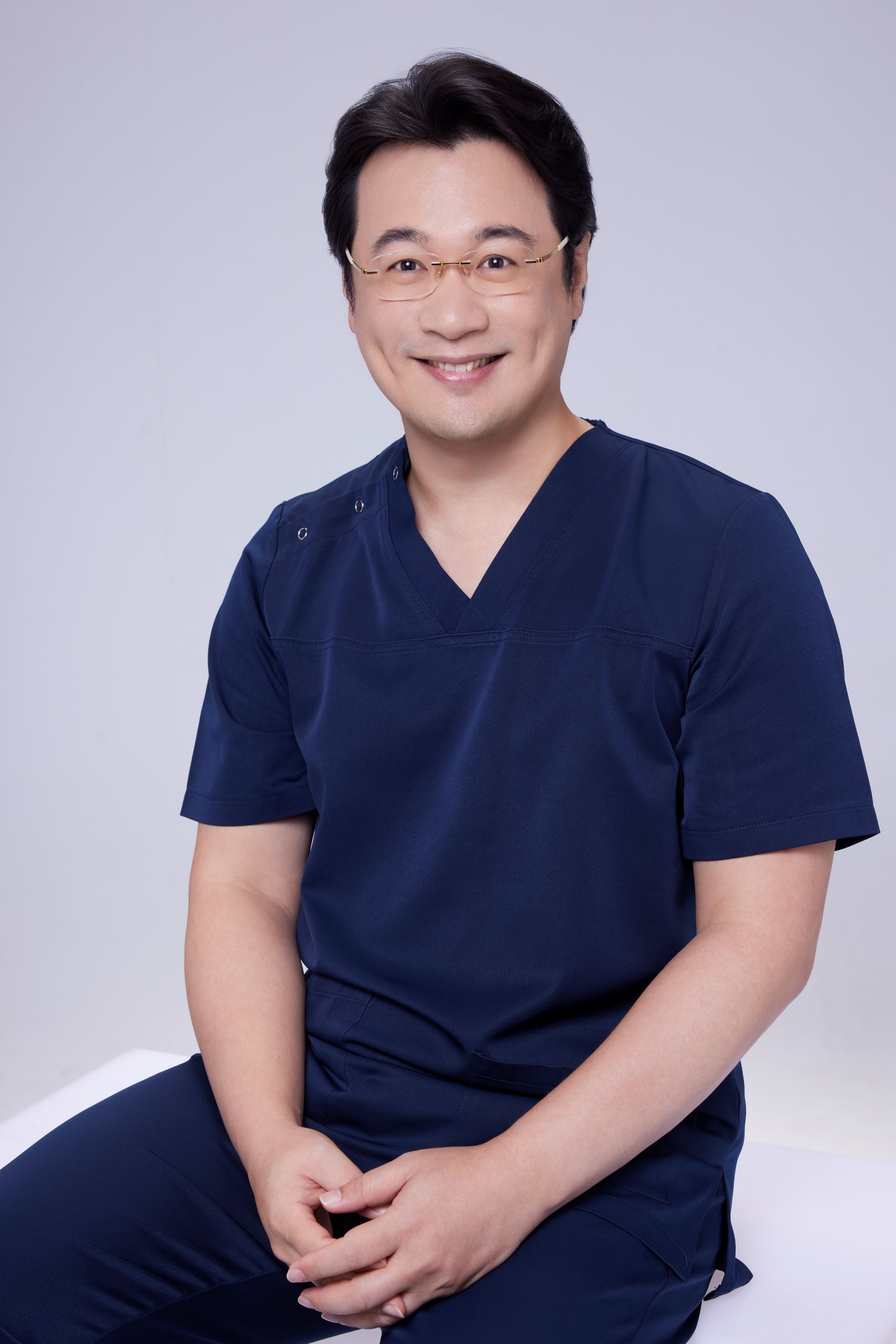
Credentials
- Kaohsiung Medical University, School of Medicine
- Attending Physician, Dermatology, Kaohsiung Chang Gung Memorial Hospital
- Attending Physician, Aesthetic Center, Kaohsiung Chang Gung Memorial Hospital
- Visiting Physician, Dermatology, Xiamen Chang Gung Hospital
- Visiting Physician, Aesthetic Center, Xiamen Chang Gung Hospital
"For every surgery, I strive to achieve a good outcome through a small incision and refined technique. Minimally invasive surgery is not just a technique — it's a commitment of respect to every patient."
Recovery after any procedure needs peer support too


Want to learn more?
Schedule a consultation for professional evaluation and advice