
Collagen Filler Complications
Injectable collagen fillers—including bovine collagen (Zyderm, Zyplast), human-derived collagen (CosmoDerm, CosmoPlast), porcine collagen (Evolence), and autologous collagen products (TheraFill, Sunmax)—were the original soft-tissue fillers, widely used from the 1980s through the 2000s. Although largely replaced by hyaluronic acid in modern practice, millions of patients still carry residual collagen filler deposits. Unlike synthetic fillers, collagen-based products inject actual foreign protein into tissue, triggering immune-mediated complications including allergic hypersensitivity reactions, granuloma formation, and chronic inflammatory nodules. These complications can appear weeks to years after injection and are resistant to standard steroid or dissolution protocols because the body's immune system actively attacks the foreign protein material.
Three Core Strengths of Liusmed Revision

Clean Removal
Stubborn masses are removed completely so residual tissue does not keep flaring.

Even Result
After removal the surface stays smooth, without new dents or waviness.

Precise, Not Excessive
Like fat grafting in reverse — the amount and location removed are judged precisely.
Common Symptoms
Foreign Protein Immune Response
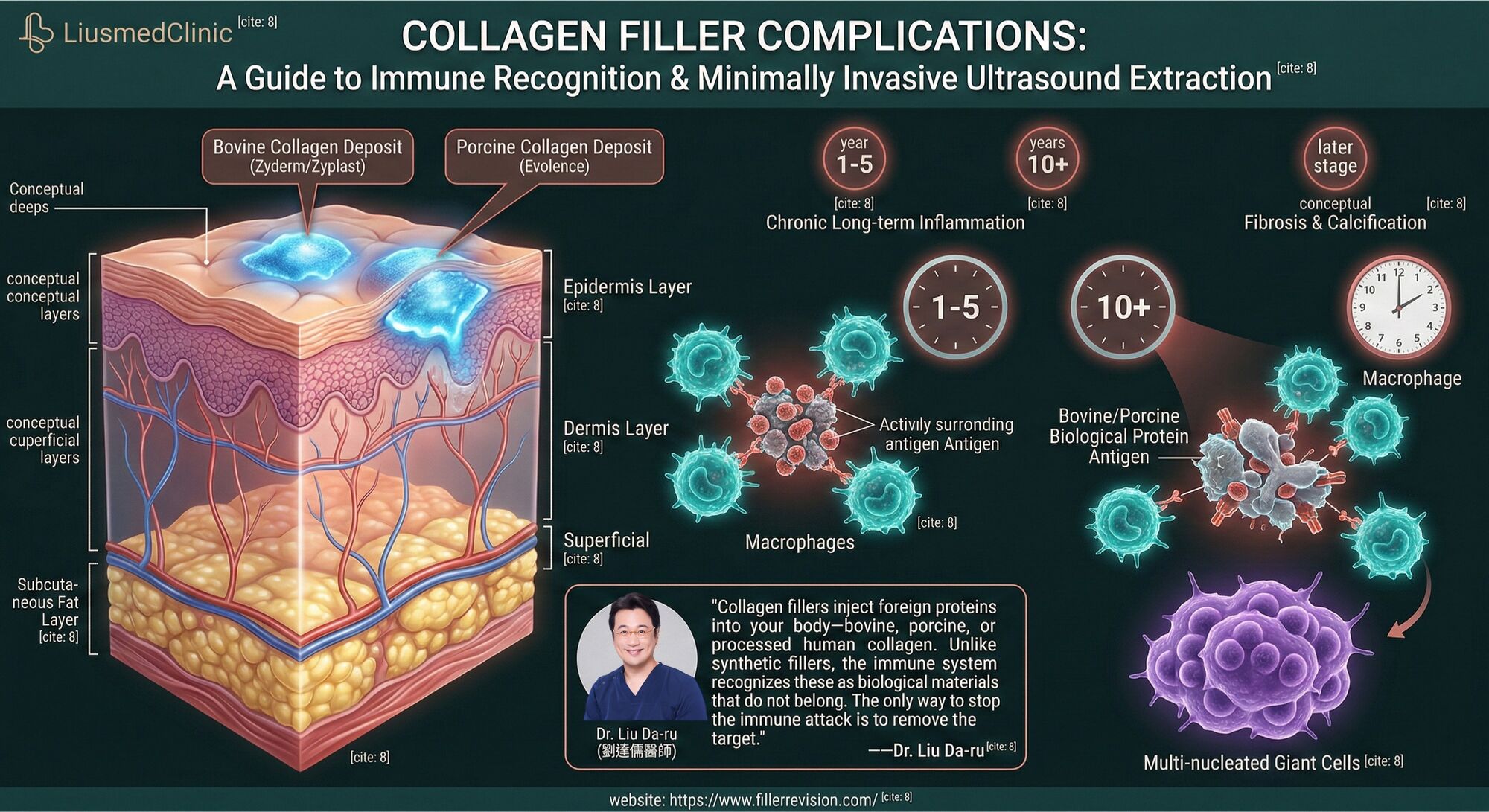
Collagen fillers are fundamentally different from synthetic fillers because they introduce foreign biological protein into tissue. Bovine collagen (Zyderm/Zyplast) contains cow-derived protein that 3-5% of patients develop antibodies against—even after passing pre-treatment skin tests. Porcine collagen (Evolence) similarly triggers immune recognition. The body's immune system identifies these foreign proteins and mounts a sustained inflammatory response: macrophages surround the collagen deposits, attempting to degrade and isolate them. This foreign body response leads to granuloma formation—organized immune cell aggregates that create firm, palpable nodules. Over time, the chronic inflammation stimulates fibrosis and calcification, transforming soft collagen deposits into hard, permanent masses. Even human-derived collagen products (CosmoDerm) can trigger reactions when injected into tissue planes where the processing has altered the protein's native structure.
Why Traditional Treatments Fail
Why Steroids and Dissolution Fail
Standard treatment protocols for collagen filler complications rely on intralesional steroid injections to suppress the immune response and 5-fluorouracil to slow fibroblast activity. While these treatments may temporarily reduce inflammation and swelling, they do not remove the foreign protein that is triggering the immune response. Steroids carry significant risks with repeated use: skin atrophy, telangiectasia, fat atrophy, and depigmentation. The immune system will reactivate once steroid effects wear off, because the antigenic stimulus—the foreign collagen—remains in place. There is no enzyme equivalent to hyaluronidase for collagen fillers; collagenase is not approved for facial soft-tissue use. This leaves patients in a cycle of steroid-suppress-flare-repeat that never achieves resolution.
“Collagen fillers inject foreign protein into your body—bovine, porcine, or processed human collagen. Unlike synthetic fillers, the immune system recognizes this as biological material that doesn't belong. The only way to stop the immune attack is to remove the target.”
Dr. LiuRemove the Antigen, Resolve the Reaction
Ultrasound-Guided Pinhole Micro-Extraction
Collagen filler complications are fundamentally immune-mediated — the body recognizes foreign protein and mounts a sustained attack against it. Steroid suppression treats the symptom (inflammation) but not the cause (foreign protein). Definitive resolution requires removing the antigenic material, not suppressing the body's natural defense response.
Foreign Protein, Not Synthetic Gel
Collagen fillers are biological material — actual animal or processed human protein. The immune system is designed to attack foreign biological material. This is a normal immune response to an abnormal situation, not a malfunction to be suppressed.
Suppression Is Not Resolution
Steroids suppress the immune response temporarily, but the foreign protein remains. When steroid effects wear off, the immune system re-engages. This cycle can continue for years without ever achieving resolution.
Extract the Target, Calm the Attack
Physically removing the collagen deposits eliminates the antigenic stimulus. Without foreign protein to attack, the immune response subsides on its own.
Ultrasound-Guided Micro-Extraction
We directly remove the collagen deposits and their surrounding fibrous capsules through pinhole entries under real-time ultrasound guidance. By physically extracting the foreign protein material, we eliminate the antigenic stimulus driving the immune response—achieving definitive resolution rather than temporary suppression. For calcified deposits, we use specialized techniques to fragment and aspirate the hardened material. The ultrasound allows us to distinguish between active inflammatory tissue, fibrotic capsule, and residual collagen product, enabling precise extraction with minimal disruption to surrounding healthy tissue.
Ultrasound Deposit Mapping
Capsulotomy & Protein Extraction
Calcification Fragmentation
Anti-Inflammatory Irrigation
Common Questions
I had collagen injections years ago—can they still cause problems?
Why do I get flare-ups when I'm sick?
Can collagen fillers be dissolved like hyaluronic acid?
What if the collagen has calcified?
Is the skin test for bovine collagen reliable?
Will the lumps come back after removal?
How long is recovery after collagen filler extraction?
Composition, brands, and removability — compiled on our filler-revision specialty site.
Not sure what is going on? Write it down and ask.
Describe what was injected, when, and what you are seeing now. Dr. Ta-Ju Liu replies in the thread with an educational explanation of what it might be, what needs to be told apart, and which signs mean you should be seen soon. Posting can be anonymous, and other patients with the same problem can read the answer too.
Replies are general health education, not a diagnosis, and do not replace an in-person examination.