A Dent After an Acne Steroid Shot: Will It Fill Back on Its Own, or Should You Repair It?
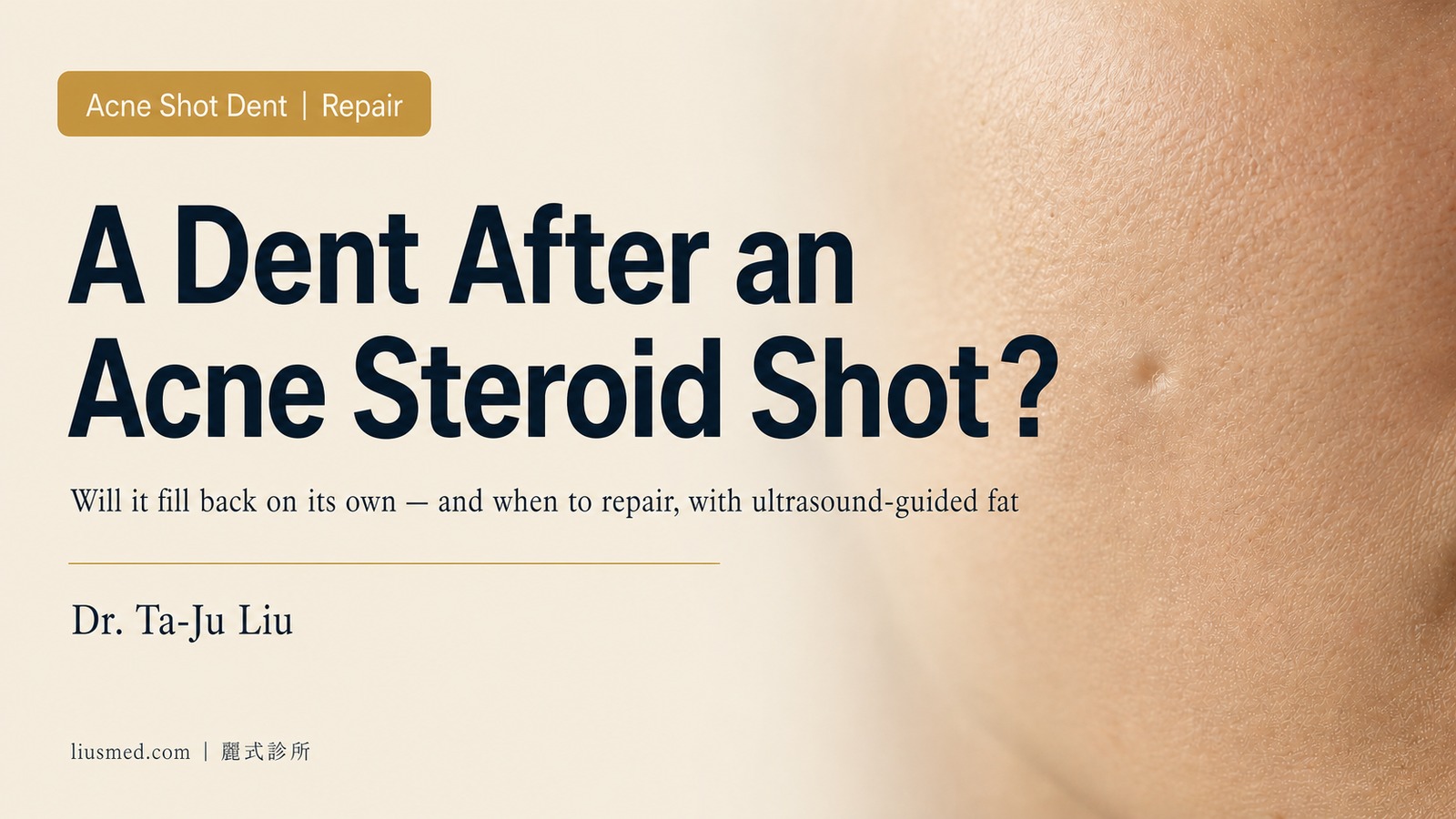
"Doctor, this was just a red, swollen pimple. I had an anti-inflammatory shot, and the next day it really did go down — I was so happy. Then two or three months later, that exact spot caved in. Now there's a dent that's more obvious than the pimple ever was."
I hear this a lot in clinic. Usually it's someone who had a steroid shot — the "acne shot" or "scar shot" — for an inflamed cystic pimple or a scar. The injection did calm the redness and soften the lump. But a while later, the skin at that spot sinks in, leaving a dent, sometimes with a bit of redness, or a patch that's paler than the skin around it.
Most people's first thought is "did I squeeze it wrong," or they're reassured with "give it six months, it'll grow back." What I want to talk about here is whether that dent actually fills back on its own, when continuing to wait is just wasted time, and what a real repair looks like when it's needed.
Why does an acne steroid shot leave a dent?
Here's something a lot of people don't realise: the dent a steroid leaves usually isn't just one thin layer of "thinned skin."
Steroid is very good at calming inflammation, but it doesn't only suppress the inflammation. It suppresses the cells that make collagen, thinning the dermis; and when it's injected deep, in larger amounts, or repeatedly into the same spot, the fat cells underneath break down and a whole block of volume is lost. So the dent you see is the result of the epidermis, dermis and subcutaneous fat all being thinned together — it's a full-thickness dent, not a surface-layer thing.
That's also why creams and even lasers often make little difference: you're treating the surface, but what's actually missing is several layers down. I go through the full mechanism in Steroid injected to shrink a lump — does it cause tissue atrophy and depression?, so if you want to understand the cause, start there.
Will it heal on its own? First separate "mild" from "severe"
There's no one-line answer to this — it depends on how deep the dent is.
A milder dent, within the first two or three months, has a chance of recovering somewhat over a year or two — that's real, not just reassurance. In that situation, stopping the steroid and giving the body some time is reasonable.
But when it's more severe and a whole block of subcutaneous fat is already gone, it doesn't really grow back. Once fat cells have died off, they aren't something that returns with a bit of rest. No matter how long you wait, the dent stays.
The problem is that with the naked eye and fingertips alone, it's hard to tell whether you're the "mild that comes back" or the "severe that doesn't." In my clinic I look with high-frequency ultrasound — which layer the dent is in, and how much subcutaneous fat is left. Once that's clear, we know whether to wait or to treat.
When is "waiting longer" just wasting time?
If you've already stopped the steroid and waited more than six months to a year, and the dent has barely changed, that usually means it isn't coming back on its own.
I've met plenty of people stuck on "let's just keep observing," who observed for a year or two, did nothing in between, and the dent stayed the whole time. Waiting itself isn't wrong — what's wrong is waiting indefinitely without first seeing clearly. One ultrasound look: if the fat layer underneath is genuinely empty in that spot, time won't fix it, and waiting longer just burns your time.
Put plainly: the mild is worth waiting on, the severe won't come back. Telling them apart takes seeing clearly, not guessing.
Do repeat saline injections help?
Some people, once they've got a dent, get sent back for repeated saline injections. This one needs to be split apart.
Saline works by diluting the steroid still sitting in the tissue and helping the body clear it. If part of your problem is still "drug residue," that helps. But saline can't create something from nothing — it can't refill fat that's already been lost. A genuine dent, where a block of volume is missing, can't be filled by injecting water; what you need is the volume put back, not more fluid in.
So if you've had several rounds of saline and the dent hasn't improved, that isn't you being impatient — it's that this method simply doesn't address the "volume loss" part.
If it does need repair, how is it repaired?
If ultrasound confirms the dent is genuine deep-layer volume loss, then the direction of repair is to put the lost volume back — and what I mainly use is your own fat.
The advantage of autologous fat is that it's your own tissue, carrying growth factors, so it lasts longer and looks more natural in the spot that lost volume. But fat grafting isn't about injecting a blob of fat and calling it done. The hard part is knowing which layer is sunken, how deep, and where the vessels run, and then, under ultrasound guidance, restoring the volume in reverse — layer by layer, precisely: smooth, and to the right layer, not blindly.
To be clear up front: this is meaningful improvement, not a guarantee of a one-hundred-percent fill. How much can be restored depends on which layer the dent is in, how large it is, how much fibrosis there is, and whether important structures are nearby. Sometimes it takes more than one session. I'll go through all of that before we start, based on what the ultrasound actually shows. This whole approach — see which layer first, then restore it precisely, layer by layer — is laid out on the steroid injection atrophy repair page if you want to understand the method.
One caution: don't get blindly injected again
One last thing worth saying: a spot that has already sunken usually has thinned tissue that isn't like normal skin anymore. If someone then, by feel alone, blindly injects fat or filler on top of it, that carries real risk — thin tissue, vessels you can't see clearly, and blindly injecting into a vessel can cause occlusion or even local tissue death.
So for repairing this kind of dent, I keep insisting on "see it first, then act." I also talk about the cases where a filler lump was injected with steroid and the normal fat atrophied along with it in What to do about skin atrophy and depression after steroid for a lump — it's the same principle: see clearly, then treat.
Common questions
Will a dent from an acne steroid shot heal on its own?
It depends on severity. A milder dent within the first two or three months, once the steroid is stopped, has a chance of recovering somewhat over a year or two. But if it's more severe and a block of subcutaneous fat has already atrophied, it usually doesn't grow back. Which one it is has to be seen on ultrasound — which layer the dent is in and how much fat is left — not judged by waiting and guessing.
It's been sunken for over a year — is there still a chance to treat it?
Yes. A dent that's barely changed after a year usually means it won't come back on its own, but that doesn't mean nothing can be done. Once ultrasound confirms it's deep-layer volume loss, autologous fat can restore the part that was lost. How long it's been sunken isn't the point; the point is seeing clearly which layer it's in and how much is missing.
I keep getting saline injections but the dent hasn't improved — did I do something wrong?
No. Saline can dilute residual steroid and help the body clear it, but it can't refill fat that's already gone. A genuine dent with a block of missing volume was never something saline could fill. The dent not improving means the method doesn't match the problem — not that you didn't try hard enough.
Can the dent be repaired so it's completely invisible?
Honestly, it's meaningful improvement, not a guarantee of a one-hundred-percent fill. How much can be restored depends on which layer the dent is in, how large it is, how much fibrosis there is, and the structures nearby. The goal is to improve the appearance and tissue thickness to a level you're comfortable with — it varies from person to person, and sometimes takes more than one session. I'll make clear beforehand how far we can get.
Back to that patient
Back to the patient from the start — the one with the anti-inflammatory shot and the dent in her cheek. I scanned it on ultrasound: the subcutaneous fat in that spot really was reduced; it wasn't still swollen, and there wasn't residue. I told her this dent wasn't likely to come back on its own, but we could use her own fat, under ultrasound, to restore the lost volume layer by layer — and I told her up front how much we could do.
Her first words to me were, "I wish I'd just let that pimple heal on its own." I understand that regret. But what's done is done; dwelling on it doesn't help. What matters is seeing clearly what the situation is now, and then deciding whether to wait or to repair.
If you've got something similar — a dent left after an injection that just won't fill — you're welcome to start with an online consultation. We'll use ultrasound to see which kind it is, and decide the next step together.
(If your dent hasn't happened yet and you're weighing whether a filler lump should get a steroid shot at all, that's a before-you-inject decision — which materials are reversible, and when not to inject at all: see Should a filler lump get a steroid shot? The material decides what's reversible on our filler-revision specialty site. This article is about repairing damage already done.)
Related specialties

Specialties
Credentials
- Kaohsiung Medical University, School of Medicine
- Attending Physician, Dermatology, Kaohsiung Chang Gung Memorial Hospital
- Attending Physician, Aesthetic Center, Kaohsiung Chang Gung Memorial Hospital
- Visiting Physician, Dermatology, Xiamen Chang Gung Hospital
- Visiting Physician, Aesthetic Center, Xiamen Chang Gung Hospital
"For every surgery, I strive to achieve a good outcome through a small incision and refined technique. Minimally invasive surgery is not just a technique — it's a commitment of respect to every patient."
Recovery after any procedure needs peer support too


Want to learn more?
Schedule a consultation for professional evaluation and advice