
Steroid Injection Atrophy & Depression Repair: Ultrasound-Guided Layering and Precise Fat Grafting
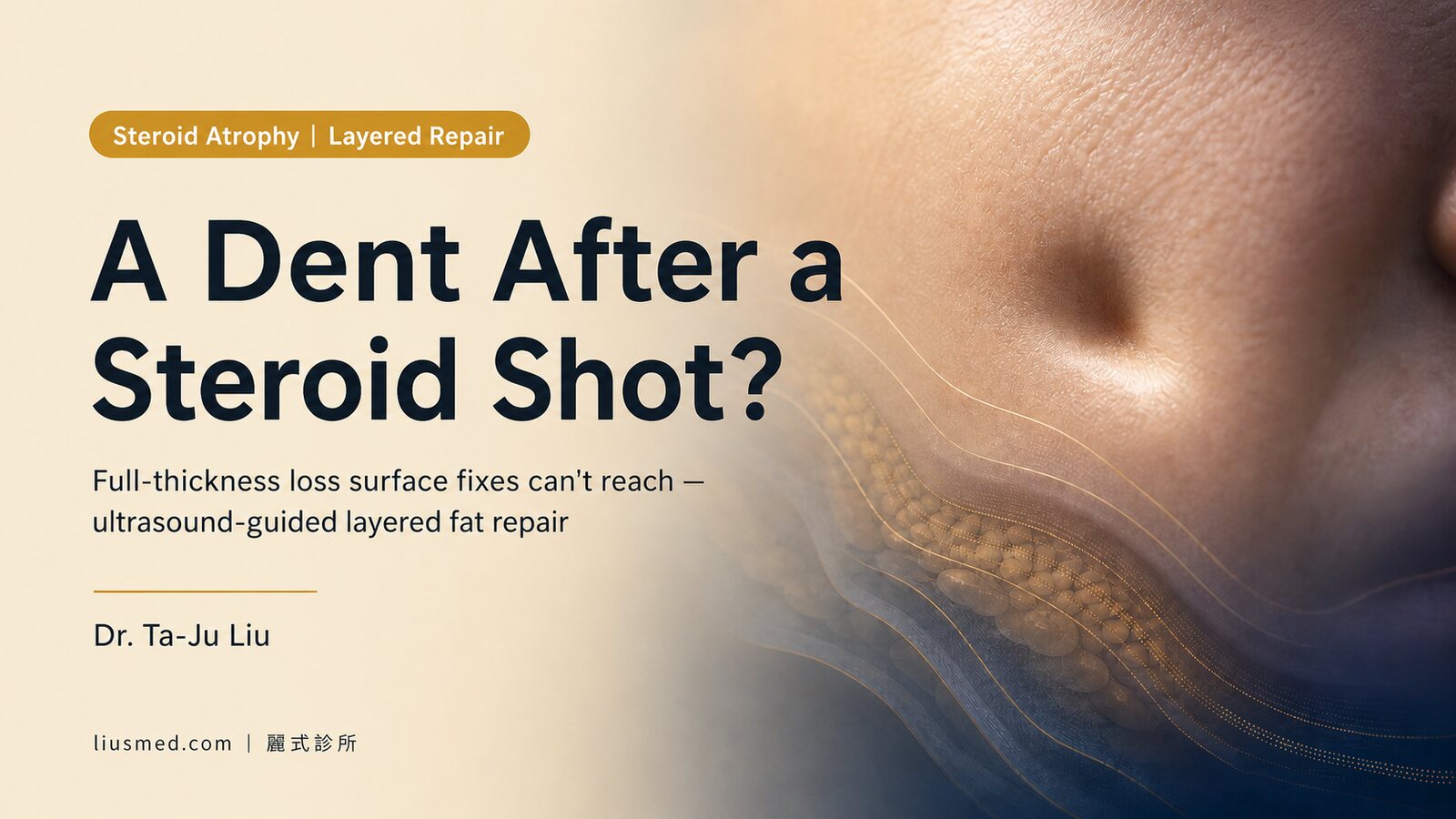
Steroid injections for acne cysts, keloid or hypertrophic scars, tendonitis or joints — even steroid injected into a filler lump to shrink it — can leave a sunken dent, thinned skin, redness or a pale patch months later. What makes it stubborn is that this isn't just one thin layer of skin: the epidermis, dermis and subcutaneous fat are all thinned, a full-thickness change, which is why surface-only treatments (lasers, creams, hydration) often can't fill it back. Many people are told to "wait six months," or keep going back for saline injections — but waiting and saline can't rebuild fat that has already died off. For steroid-induced atrophy and depression that has already happened, we offer high-frequency ultrasound layer-by-layer mapping, assessment for residue and inflammation, and precise volume restoration led by autologous fat. How much can be restored depends on which layer the depression sits in, its extent, fibrosis and nearby structures — it is meaningful improvement, not a guarantee of one-hundred-percent fill.
Three Core Strengths of Liusmed Revision

Clean Removal
Stubborn masses are removed completely so residual tissue does not keep flaring.

Even Result
After removal the surface stays smooth, without new dents or waviness.

Precise, Not Excessive
Like fat grafting in reverse — the amount and location removed are judged precisely.
Common Symptoms
Why steroid injections leave a depression
Steroid is good at calming inflammation and suppressing overgrowth, but it also suppresses fibroblasts and cuts off collagen synthesis, thinning the dermis; when it is injected deep, in large amounts, or repeatedly, the subcutaneous fat cells break down and undergo apoptosis, so a whole block of volume is lost. That's why a steroid depression usually isn't a single layer — the epidermis thins and shows broken capillaries, the dermis collapses, and the subcutaneous fat is lost in bulk. It's also why, before any repair, we first sort out which layer is sunken and how deep: if the layer you fill doesn't match the layer that was lost, it won't fill back.
Why Traditional Treatments Fail
Why waiting and repeat saline don't work
Mild steroid atrophy can genuinely recover slowly over a year or two — that's real. But when it's more severe and the fat has already died off, it doesn't grow back on its own. What saline can do is dilute residual steroid and help the body clear it — it cannot conjure lost volume out of nothing. Lasers help surface texture but do little for a deep dent; hyaluronic acid can prop up volume temporarily but is metabolised away and tends to show through thinned tissue. So the point isn't to wait longer or dilute again, but to first see clearly which layer is sunken and do the matching layer-by-layer repair.
“I first use ultrasound to see exactly which layer is sunken and how much is lost. For volume that's genuinely gone from the deep layer, restoring it precisely with your own fat is more real than waiting and repeating saline. How much can be restored I'll tell you honestly — it varies from person to person, and sometimes it takes more than one session.”
Dr. LiuSteroid depression repair is won on layering and precision
Ultrasound-guided autologous fat layer repair
Handling steroid depression follows the same thinking as the filler repair I've done for years: see clearly first, then restore what should be restored in a precise way, rather than blindly injecting a lump on top. The hard part isn't putting fat in — it's knowing which layer is sunken, how much is lost, and where the vessels are, then restoring it in reverse, precisely: smooth, and to the right layer. I have over a decade of experience with subcutaneous tissue, fibrosis and fat grafting, and this — see clearly first, then restore precisely — is the key to steroid depression repair.
See which layer is sunken first
Steroid depression is often full-thickness: thin epidermis, collapsed dermis, a missing block of subcutaneous fat. Ultrasound maps the layers and measures the depth first, so the treatment matches the layer.
Restore deep-layer loss precisely with autologous fat
The volume genuinely lost is restored precisely under imaging, led by autologous fat — avoiding vessels, kept smooth, not a blindly injected lump.
Honestly outline how much can be restored
It's meaningful improvement, not a guarantee of a one-hundred-percent fill; it varies from person to person and sometimes takes more than one session. I'll make the achievable range clear before the procedure.
Map the layers on ultrasound first, then restore precisely
For steroid depression that has already formed, we don't rush to inject something on top. First we map it layer by layer on high-frequency ultrasound: whether the dent is in the epidermis, dermis or subcutaneous fat, how deep it is, where the vessels run, and whether steroid residue remains. For cases with recurrent inflammation, we assess and rule out infection first, rather than pressing down again with high-dose steroid. Once it's clear, volume genuinely lost in the deep layer is restored precisely, led by autologous fat; thinned, reddened surface layers are then addressed accordingly. The whole process stays under imaging to avoid vessels.
High-frequency ultrasound layer mapping (which layer, how deep, vessels and residue)
Inflammation and residue assessment: no high-dose steroid before infection is ruled out
Deep-layer volume loss restored precisely, led by autologous fat
Confirm a smooth result, avoid vessels, and honestly outline what can be restored
Common Questions
Will a depression from a steroid injection heal on its own?
Do repeat saline injections help?
What is used to restore it — a collagen stimulator or autologous fat?
How much can be restored?
Articles in this series
Not sure what is going on? Write it down and ask.
Describe what was injected, when, and what you are seeing now. Dr. Ta-Ju Liu replies in the thread with an educational explanation of what it might be, what needs to be told apart, and which signs mean you should be seen soon. Posting can be anonymous, and other patients with the same problem can read the answer too.
Replies are general health education, not a diagnosis, and do not replace an in-person examination.