A Dent After a Scar-Reducing Injection: Can Steroid Atrophy Be Repaired?
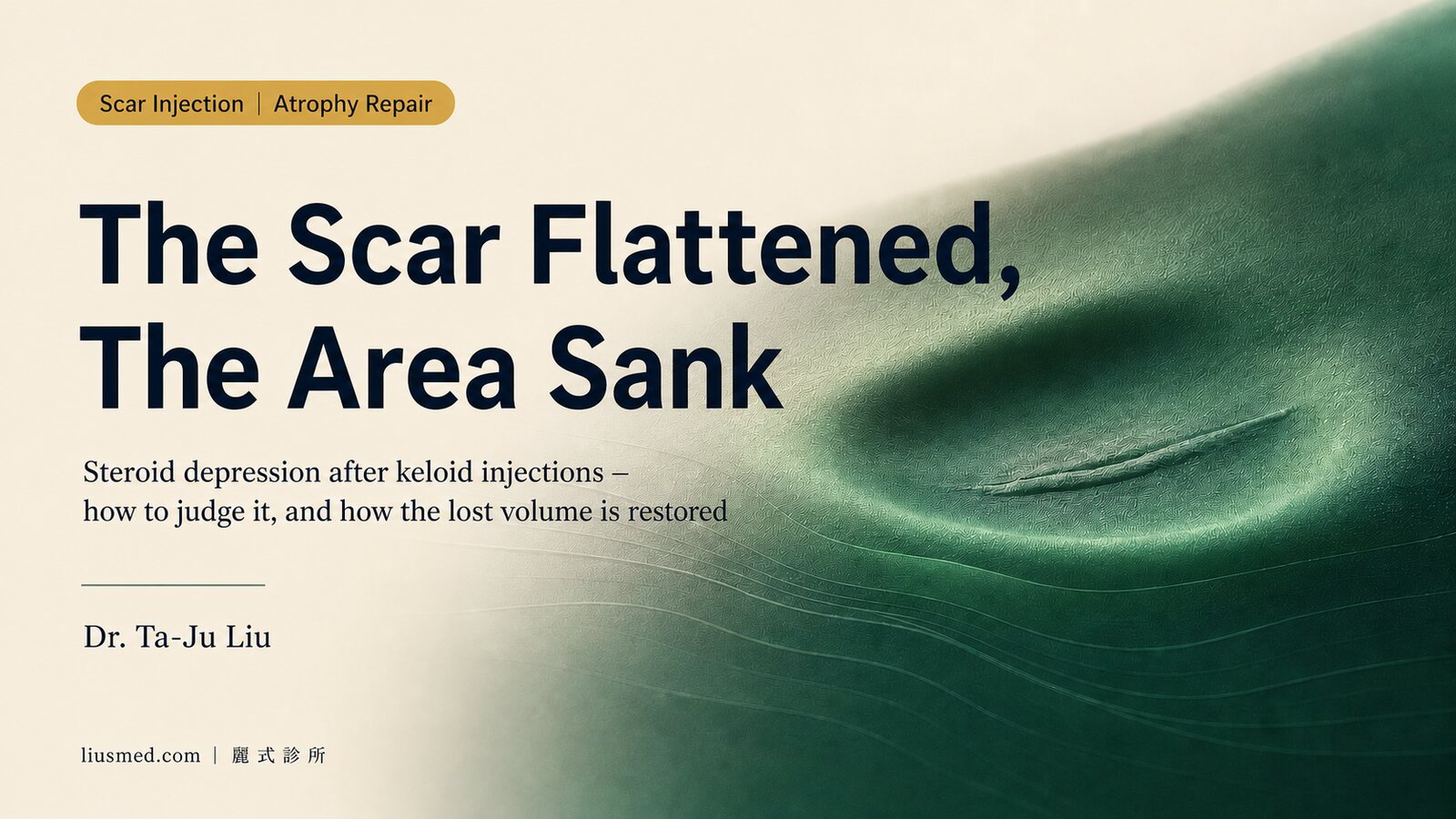
"The scar did flatten, doctor. But now the whole area is sunken, and it looks stranger than it did before."
I hear that often. The injection flattened the scar, but the cost was that the healthy tissue beside it sank as well. That is not an illusion, and it is not swelling that has yet to settle. Something is genuinely missing.
A student's elbow
He was still at school age. After an injury, a keloid formed on his elbow, about four to five centimetres across and thick to the touch.
He had two scar-reducing injections elsewhere. The keloid did flatten; that part worked. The problem was that the normal tissue around it thinned out and sank as well, until the whole area had collapsed together. His mother knew I do this kind of repair work, so she brought him in.
By the time I saw him there was an obvious depression around the elbow, not just at the scar itself. It showed up even more when he straightened his arm, with the whole patch dipping down. The first photo above shows what that sunken scar looked like; the second, taken from the side, shows the contour of the dip.
Why the area around the scar sinks too
Let me be clear first: there is nothing wrong with a scar-reducing injection.
The problem with keloids and hypertrophic scars is that fibroblasts are overactive and collagen keeps building, beyond the boundary of the original wound. Suppressing that overgrowth is exactly what a steroid is for. Used properly, it works well.
What it cannot do is tell which part is scar and which part is your own subcutaneous fat. The drug spreads once it is in. Give enough of it, spread it wide enough, and the layer that should have stayed gets suppressed too. Steroid inhibits fibroblasts and reduces collagen synthesis, so the dermis thins; inject deep, in volume, or repeatedly, and the subcutaneous fat cells break down and die off, so the volume in that patch is genuinely lost.
That is why you end up with a contradictory picture: the scar really is flat, but it got flat by taking the surrounding tissue down with it. It also explains why scars that need repeated injections, like keloids, carry a higher chance of this than a one-off treatment.
This is not the same as an ordinary scar depression
People often lump it in with acne scarring, but it is a different problem.
An acne dent is usually dermal damage with fibrous tissue tethering the surface downwards, so treatment leans towards rebuilding the surface and releasing the tether. A steroid-induced depression is a loss of volume — the epidermis thins, the dermis collapses, and the subcutaneous fat is lost as a block. It is full-thickness atrophy, thinning all the way down.
The practical difference matters: however much laser or topical treatment you do on the surface, it will not put back tissue underneath that is genuinely gone. The direction is wrong, so no wonder nothing fills it.
How do you tell which one you have? If the dent sits where the needle went, covers a wider area than the original scar, and the skin looks thin, translucent, or shows fine broken vessels, it is most likely steroid-induced. On the face this gets harder to judge, and I have written separately about telling one kind of facial dent from another.
Will it recover on its own, and when should it be treated?
Sometimes yes, sometimes no. It depends on severity.
Mild atrophy does have a chance of filling back in over a year or two. That is real, and it does not need rushing. But once the whole area has collapsed and fat cells have genuinely died off, it will not regrow by itself.
One point deserves special mention. Many people are told to go back for saline injections. What saline can do is dilute steroid still sitting in the tissue so the body clears it — which is meaningful if the injection was recent and the drug is still there. What it cannot do is create volume out of nothing. So repeating saline months or years after the dent appeared usually just uses up your time.
My rough rule: within three to six months of the injection, with a shallow dent, watching is reasonable. Past a year, still there, clearly defined, or collapsed as a block the way this boy's was — stop waiting. Waiting has its own cost, particularly at an age when you face your classmates every day.
How I approach it: look first, then replace the volume
The thing this kind of depression can least afford is another blind injection. The tissue is already thinned and tethered, and it does not behave like normal tissue. Going in on feel alone at that point is risky.
So the first step is not injecting, it is looking. High-frequency ultrasound maps the depression in layers: whether it sits in the epidermis, the dermis, or the subcutaneous fat, how deep it goes, how much fat is left underneath, where the vessels run, and whether any steroid is still present. Only then do I know which layer to fill and how much.
For volume genuinely lost in the deep layer, I mainly use your own fat. Autologous fat is your own tissue and carries growth factors, so besides restoring volume it helps improve the tissue environment in a poorly perfused area — longer-lasting, and more natural to the touch. The whole procedure is done under imaging to avoid vessels; fat entering a vessel carries a risk of occlusion, and that has to be said honestly.
This patient's elbow filled in one session, with no need to repeat. How many sessions it takes still depends on how wide and how deep the depression is, and it varies from person to person. I will not promise a single visit. The technique itself is covered in ultrasound-guided layered fat grafting.
Fat grafting and scar-fading are two different things
This is the part most easily misread, so I want to be explicit.
In the photos you can see two things improved at once: the depression filled, and the scar faded. Those did not come from the same course of treatment.
The depression was addressed with autologous fat grafting, which deals with lost volume. The scar itself faded after two or three separate scar-fading sessions, which deal with the mark left on the surface. Different goals, different methods, different number of visits.
I spell this out because expecting one fat graft to fix the scar as well leads to disappointment. The reverse is also true: scar-fading alone leaves the dent exactly where it was. Which one matters to you decides what to do first — or whether you want both addressed.
Frequently Asked Questions
Does a scar-reducing injection always cause a dent?
No. Most people do not get one, which is why steroid injection remains a standard treatment for hypertrophic scars and keloids. Depressions turn up more often with higher doses, repeated sessions, or when the drug spreads into the surrounding normal tissue. Scars like keloids that often need repeated injections carry relatively more risk, which makes control of depth and dose more important.
It has been sunken for three years. Can it still be repaired?
The length of time is not itself the deciding factor; which layer is affected and how much is missing are. Fat that has already died off will not regrow because you waited longer, so the difference between one year and three is usually not whether it can be filled, but how long you have already lost. An ultrasound assessment of the layers is what tells you how much can be restored.
Can I just fill it with hyaluronic acid or a collagen stimulator?
Hyaluronic acid can prop up volume temporarily, but it metabolises away and tends to show through tissue that is already thin. With collagen stimulators I am more conservative still: injected poorly they readily form lumps and cannot be dissolved, and removing them is a large part of my routine work. So for steroid-induced depression my mainstay is autologous fat plus ultrasound precision, not stacking stimulators into a dent.
Can children or teenagers have this done?
It needs individual assessment. This patient was still at school age, and after evaluation autologous fat was appropriate for him. With younger patients I look more conservatively at whether the depression has stabilised, whether it is still changing, and whether there is an adequate donor site — all confirmed first, and decided together with the parents.
Will it sink again after it is filled?
How much grafted fat survives varies from person to person and is not one hundred percent, and I say so from the start. The portion that survives stays long term; if the original depression was deep or wide, more than one session may be needed. Whether a new dent appears is a separate question, and that depends on whether more steroid goes in.
Closing
Back to that boy. When his mother brought him in, what worried her most was not the scar. It was the dent that looked wrong from every angle.
I scanned it, drew out for them which layer had collapsed and how much was missing, and said: this can be filled with his own fat, and I will tell you up front how far it can go. The depression was filled, and after two or three scar-fading sessions the mark gradually settled as well.
If you or someone in your family has a dent after a scar-reducing injection, do not simply keep waiting. Mild cases have a chance of recovering; once the whole area has collapsed, they do not. You are welcome to start with an online consultation, so we can use ultrasound to see which kind of depression you have and whether fat grafting fits, and decide together from there.
The photo at the top of this article is this patient's case; the full before-and-after is in this entry of our case gallery, which you can open and look through yourself.
(If your dent has not happened yet and you are weighing up whether a filler lump should be treated with steroid at all, that is a decision made before the injection — which materials are reversible, and when it should not be done. See our filler-revision site: Should a filler lump be treated with steroid? The material decides whether it is reversible. This article is about repairing damage that has already happened.)
Related Specialties
Specialties
Credentials
- Kaohsiung Medical University, School of Medicine
- Attending Physician, Dermatology, Kaohsiung Chang Gung Memorial Hospital
- Attending Physician, Aesthetic Center, Kaohsiung Chang Gung Memorial Hospital
- Visiting Physician, Dermatology, Xiamen Chang Gung Hospital
- Visiting Physician, Aesthetic Center, Xiamen Chang Gung Hospital
"For every surgery, I strive to achieve a good outcome through a small incision and refined technique. Minimally invasive surgery is not just a technique — it's a commitment of respect to every patient."
Recovery after any procedure needs peer support too


Want to learn more?
Schedule a consultation for professional evaluation and advice