A Facial Dent After an Injection: Is It Steroid Atrophy? Telling Facial Dents Apart and Repairing Them
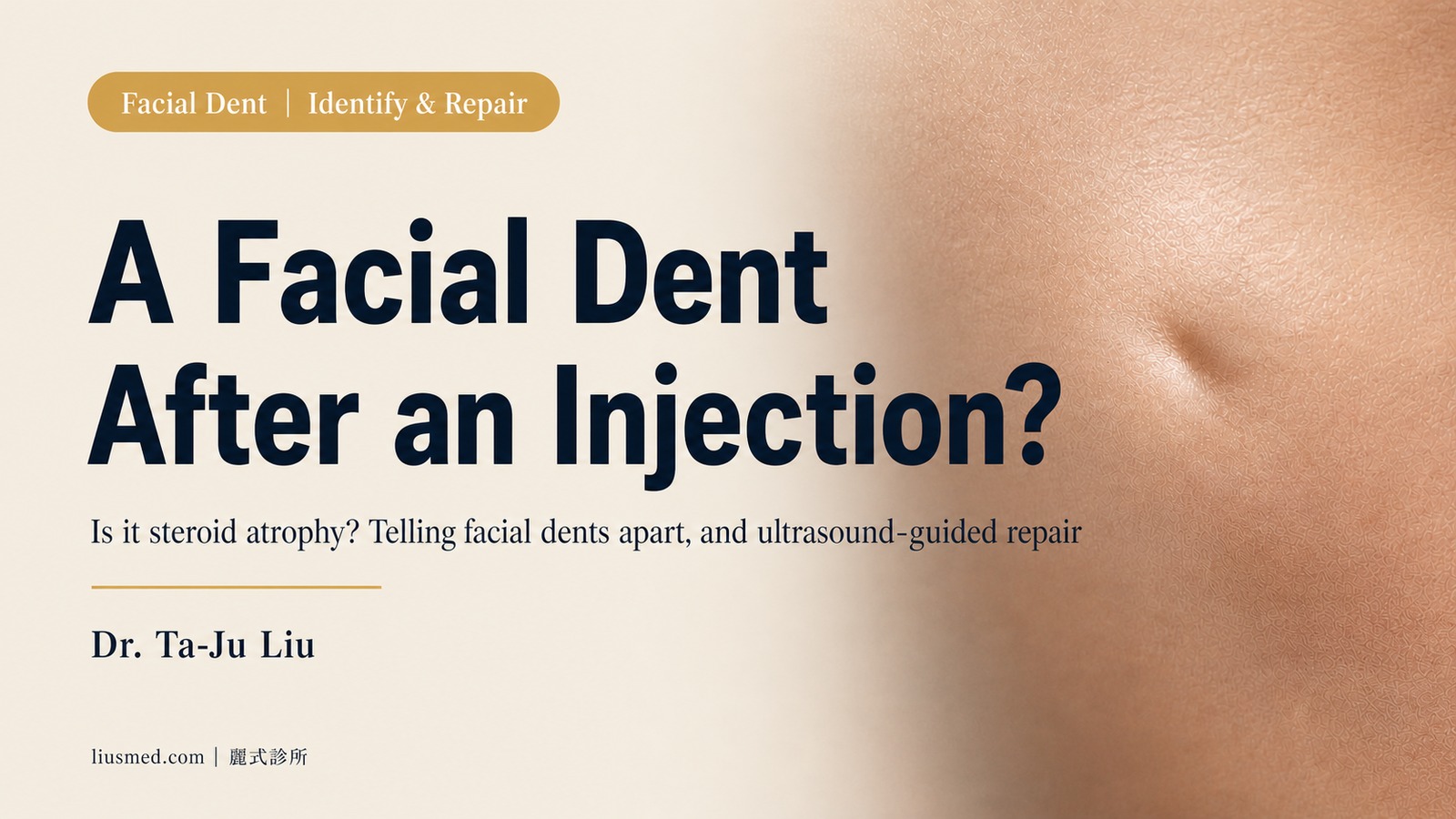
"Doctor, I have a dent here, but I can't figure out why. I've had an injection in this area before, but I've also had acne here, and had hyaluronic acid too — so which one caused it?"
People who come to me about a facial dent often carry this exact confusion. What they really want to know is two things: how the dent came about, and whether it can be repaired. And those two are linked — because without first working out which kind of dent it is, you can't decide how to repair it. So today I want to talk about telling facial dents apart, and especially how to judge whether one is caused by steroid.
A dent on your face — first work out which kind
There's more than one reason a face can dent. The common categories are roughly these:
- Atrophy from a steroid injection: an acne shot, a scar shot, or steroid injected into a filler lump — the tissue there gets thinned and the fat lost, and it caves in.
- Atrophic acne scar: after acne inflammation, the dermal collagen is destroyed, leaving a pit or depressed scar.
- A dent from migrated or reabsorbed filler: filler you had before has moved or been metabolised, so the spot it was propping up collapses.
- A congenital or ageing dent: like a tear trough, or depression from tissue descending and losing volume with age.
These dents can look quite similar, but they differ in cause, in depth, and in the layer that needs repairing. Treating them as the same dent and filling them the same way often misses. So the first step isn't to rush to fill — it's to sort out which kind you have.
How to tell if it's caused by steroid
A steroid-caused dent has a few clues that help.
First, history: has this spot been injected? An acne shot, a scar shot, or an anti-inflammatory / steroid shot after a filler lump? If so, and the timing fits, it's worth strongly suspecting.
Next, appearance: a steroid dent often isn't just a dent — it may come with thinned, translucent, reddened skin, or even a patch that's paler than around it (hypopigmentation), and sometimes fine visible capillaries. That's because it damages the full thickness from epidermis and dermis down to subcutaneous fat, not just a missing block of volume.
And timeline: a steroid dent usually doesn't appear right after the shot, but emerges gradually over two or three months. Many people feel the swelling went down and it worked well at first, only noticing something's wrong once it sinks.
That said, looking and feeling can only get you to "strongly suspect." To actually confirm which layer it is, how deep, and how much fat is left, you still need high-frequency ultrasound to see clearly — which is also the key to deciding how to repair it.
Why a dent on the face needs extra care to repair
The same dent is harder to treat on the face than elsewhere on the body, because of how the face is built.
Many parts of the face have thin skin over important vessels and nerves — especially the under-eye area, the temples, and the bridge of the nose, where the tissue is already thin, a dent shows especially clearly, and there's little room to work. On top of that, tissue already thinned by steroid may have vessels pulled out of position, so blindly injecting fat or filler here by feel risks going into a vessel, causing occlusion or local tissue death — a serious complication on the face.
So for facial dents, my principle is always: see it first, then act. Not opening the face up to search, but using ultrasound to see the layers, depth and vessels clearly, then treating precisely with the smallest action.
Different dents are repaired differently
Once you've worked out which kind of dent it is, you know which way to repair it:
- A steroid-atrophy dent: at its core, a block of deep-layer volume is genuinely gone; the direction is to see the layers clearly on ultrasound, then use autologous fat to restore the loss layer by layer. The full process is laid out on steroid injection atrophy repair.
- An atrophic acne scar: this treats a scar where the dermis was destroyed, which is different from restoring volume; the grading of different scars and their matching treatments are covered separately in scar-grading treatment.
- A dent from migrated or residual filler: sometimes the moved or residual filler has to be dealt with first, rather than filling on top of it. For the case where a filler lump was injected with steroid and the normal fat atrophied along with it, see what to do about skin atrophy and depression after steroid for a lump.
The point is: don't treat every facial dent as "missing volume, just fill it." Identify first, then match the treatment — otherwise it gets messier the more you fill.
Repairing a facial dent: seeing clearly matters more than filling fast
The last thing I want to stress is the same line: for repairing a facial dent, seeing clearly matters more than filling fast.
I know many people are in a hurry to get the dent filled, ideally in one go. But on the face — thin skin, many vessels, complex layers — filling in a rush, filling blind, carries a higher chance of risk and unevenness. See your dent clearly on ultrasound first — which kind, which layer, how deep, where the vessels are — then decide whether to fill, how, and how far it can go. That's what makes it steady and safe.
How much can be restored I'll say honestly too: it's meaningful improvement, not a guarantee of a one-hundred-percent fill, it varies from person to person, and it sometimes takes more than one session. All of that I make clear before treating.
Common questions
There's a dent on my face — how do I know if it's from an injection?
First, history: has this spot had an acne shot, a scar shot, or steroid into a filler lump? Then, features: a steroid dent often comes with thinned, reddened, or even locally paler skin. And timing: it usually emerges only two or three months after the shot. With these clues it's worth strongly suspecting, but confirming which layer and how deep still takes ultrasound.
Is a dent on the face treated the same as one elsewhere on the body?
No. Many parts of the face have thin skin over important vessels and nerves — especially the under-eye, temples and nose bridge — so there's little room and higher risk when repairing. That's why a facial dent especially needs ultrasound to see the layers and vessels clearly, seeing first and then acting, rather than injecting blind by feel.
Are an atrophic acne scar and a steroid dent the same thing? Can they be filled together?
They aren't the same. An atrophic acne scar is a dermal scar; a steroid dent is deep-layer volume loss — they damage different layers and are repaired differently. Treating them as one and filling them the same way often misses. You have to sort out which kind it is first — and you might even have both — then treat each accordingly.
Do facial dents repair well?
It depends which kind of dent, which layer, and how large. For a deep dent caused by steroid, ultrasound-guided layered fat repair can achieve clear improvement in most cases — but it's clear improvement, not a guarantee of a one-hundred-percent fill; it varies from person to person and sometimes takes more than one session. I'll make it clear before treating, based on what the ultrasound shows.
Finally
Back to the patient from the start, unsure where the dent came from. I scanned it on ultrasound and, cross-checking his history, judged the dent was mainly tissue atrophy after an earlier injection — a block of deep fat gone, not simply an acne scar. Once the cause was clear, the repair direction was clear.
With a dent on your face, the worst thing is to rush around filling before you've worked out which kind it is. Identify first, then match the treatment — that's the right order. If you've got something similar and aren't sure how your facial dent came about or whether it can be repaired, start with an online consultation; we'll use ultrasound to see clearly, and decide the next step together.
(If your dent hasn't happened yet and you're weighing whether a filler lump should get a steroid shot at all, that's a before-you-inject decision — which materials are reversible, and when not to inject at all: see Should a filler lump get a steroid shot? The material decides what's reversible on our filler-revision specialty site. This article is about repairing damage already done.)
Related specialties

Specialties
Credentials
- Kaohsiung Medical University, School of Medicine
- Attending Physician, Dermatology, Kaohsiung Chang Gung Memorial Hospital
- Attending Physician, Aesthetic Center, Kaohsiung Chang Gung Memorial Hospital
- Visiting Physician, Dermatology, Xiamen Chang Gung Hospital
- Visiting Physician, Aesthetic Center, Xiamen Chang Gung Hospital
"For every surgery, I strive to achieve a good outcome through a small incision and refined technique. Minimally invasive surgery is not just a technique — it's a commitment of respect to every patient."
Recovery after any procedure needs peer support too


Want to learn more?
Schedule a consultation for professional evaluation and advice