How LI-SWT Shockwave Therapy Works: Angiogenesis Explained
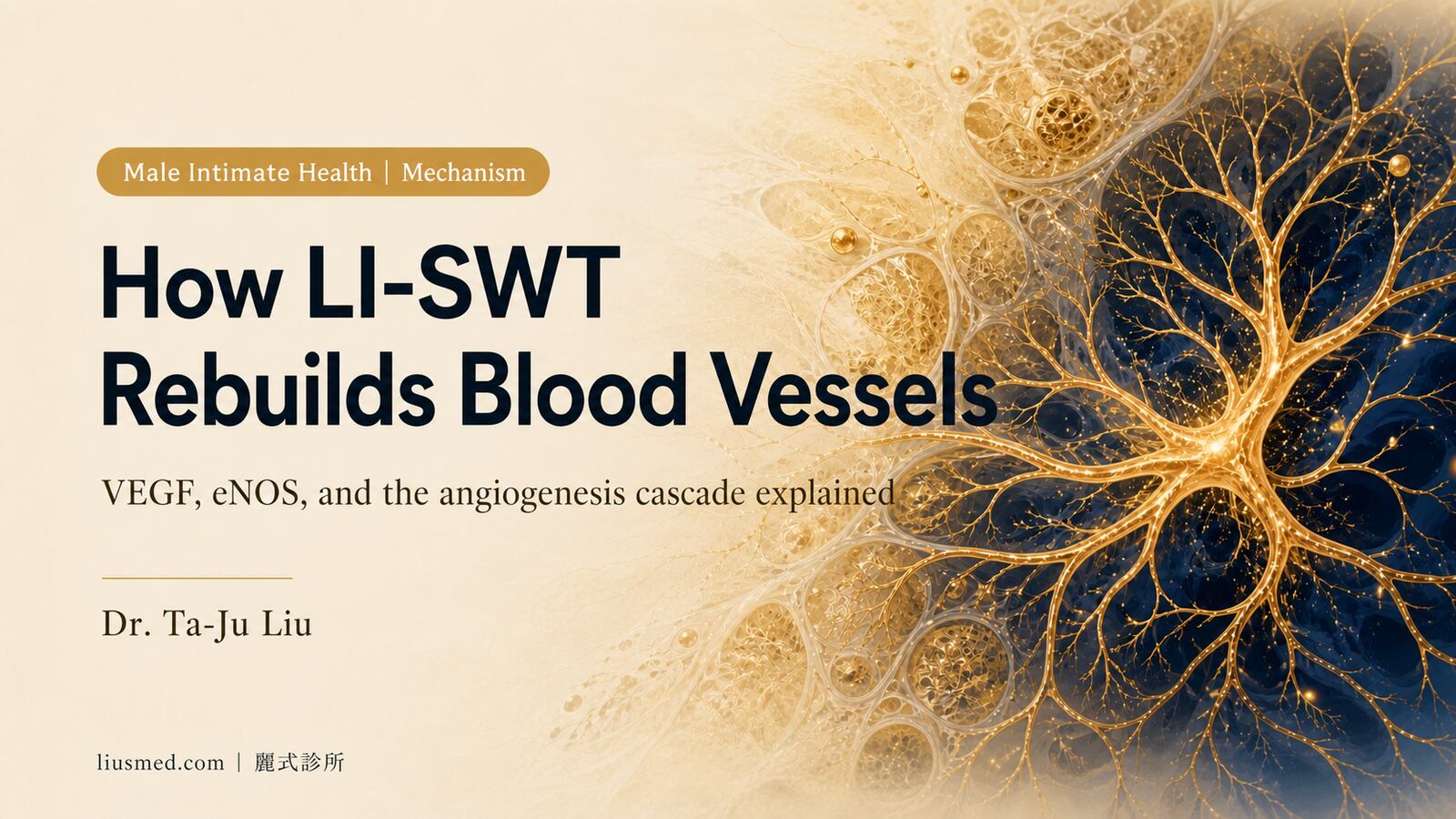
Low-intensity shockwave therapy (LI-SWT, also written LI-ESWT) does one thing at its core: it uses precisely calibrated mechanical pressure to trigger the body's own blood vessel growth program. The medical term for this is angiogenesis (the outward sprouting of new capillary networks from existing blood vessels).
That's fundamentally different from how PDE5 inhibitors (sildenafil, tadalafil) work. Oral medications temporarily relax existing blood vessels so blood can enter; shockwave therapy is an attempt to rebuild the vascular bed itself. This distinction matters when choosing between these two approaches: one works on-demand, the other aims for lasting structural change.
What the shockwaves actually do
LI-SWT delivers longitudinal acoustic pressure waves that travel through tissue and converge at the target site, creating a positive pressure peak followed by a negative pressure phase. That negative phase generates transient microbubbles (a phenomenon called acoustic cavitation), and when those bubbles collapse, they create localized mechanical stress in the tissue.
"Low intensity" is the operative phrase. High-energy shockwaves (used in kidney stone lithotripsy) are designed to destroy target structures. Low-intensity shockwaves, at energy densities typically below 0.09 mJ/mm², are designed to stimulate: triggering the body's own repair cascade rather than causing uncontrolled damage.
The biological cascade: how angiogenesis gets started
In the corpus cavernosum (the main erectile tissue of the penis), LI-SWT's mechanical stress sets off a chain of biological events.
The first link is VEGF release. Mechanical stress prompts endothelial cells and surrounding tissue to release vascular endothelial growth factor (VEGF), the primary signaling molecule for blood vessel growth. VEGF tells the tips of capillaries to extend in the direction of the stimulus, driving the formation of new microvessels.
Simultaneously, the shear stress activates endothelial nitric oxide synthase (eNOS), raising local concentrations of nitric oxide (NO). NO plays a dual role: it relaxes existing blood vessels to improve immediate perfusion, and it creates a microenvironment conducive to new vessel growth.
Finally, the local VEGF gradient recruits mesenchymal stem cells to the stimulated area, where they participate in tissue remodeling. The net result of this cascade is an expanded microvascular bed in the corpus cavernosum: more capillaries, better perfusion, improved erectile capacity.
Key point: LI-SWT doesn't produce an immediate effect because it isn't causing immediate vasodilation. It's starting a biological construction project that takes weeks to complete. Communicating this expectation clearly at the outset is part of the evaluation process.
Mechanism comparison
Here's how the three main male intimate treatment modalities compare at the mechanism level:
| LI-SWT Shockwave | PDE5i Oral Medication | PRP Growth Factors | |
|---|---|---|---|
| Target | Angiogenesis, rebuild corpus cavernosum vasculature | Inhibit PDE5 enzyme, prolong NO action | Deliver growth factors directly, promote tissue repair |
| Onset | Cumulative over weeks to months | On-demand, effective in 1-2 hours | Varies, weeks to months |
| Structural change | Yes (this is the goal) | No (functional, temporary effect) | Partial (growth factor-mediated repair) |
| Best fit | Mild-to-moderate vasculogenic ED | First-line for most ED | Combined with shockwave or standalone |
| EAU guideline status | Conditionally recommended (2024-2025, weak rating) | Strongly recommended first-line | Emerging option, evidence accumulating |
For a detailed comparison of all three options: Oral Medication vs. Shockwave vs. PRP: A Complete Comparison of Male Erectile Function Treatments
What the EAU guidelines say
The European Association of Urology (EAU) is the most internationally recognized body for male sexual health guidelines. Their 2024-2025 edition recommends LI-SWT for mild vasculogenic ED in patients who are well-informed and prefer an alternative to long-term oral medication, or who respond poorly to PDE5 inhibitors, with a weak strength of recommendation.
The "weak" rating reflects the state of the research, not the clinical utility. LI-SWT is widely used with good patient-reported outcomes, but EAU requires more uniform RCT data before issuing a strong recommendation. Current trials vary significantly in energy levels, treatment protocols, and device types.
A 2024 umbrella review in MDPI synthesized multiple LI-ESWT studies and found statistically significant improvements in IIEF (erectile function) scores and penile rigidity, with the strongest effects in mild-to-moderate vasculogenic cases.
Key point: Shockwave works through a vascular mechanism. It isn't designed for purely psychogenic ED or severe neurogenic ED (such as post-radical prostatectomy nerve damage). Identifying the ED subtype is a core part of the initial evaluation. For background on ED causes and types: Why Does Erectile Dysfunction Happen? Understanding Vasculogenic, Neurogenic, and Psychogenic Types
Who's a good candidate, and who needs further evaluation
Shockwave has clearer evidence in these situations:
- Mild-to-moderate vasculogenic erectile dysfunction
- Patients who want to improve baseline vascular function rather than rely on medication long-term
- Peyronie's disease: LI-SWT has a separate EAU indication for this condition
These situations are not primary indications and need a full evaluation first:
- ED with predominant psychogenic components
- Severe diabetic neuropathy, or neurogenic ED after radical prostatectomy
If you're unsure of your own situation, the IIEF-5 self-assessment is a good starting point: a validated five-question screening tool that Dr. Liu routinely has patients complete before their initial consultation.
How shockwave works with PRP
The two modalities are mechanistically complementary. Shockwave improves the local vascular microenvironment and initiates angiogenic signaling; PRP (platelet-rich plasma) supplies exogenous growth factors to accelerate local tissue repair.
Whether combining them makes sense for a given patient, and in what sequence, depends on individual assessment, not a fixed protocol.
Complete Guide to Male Intimate Shockwave and PRP goes through the treatment architecture in detail.
Our male intimate repair service begins with evaluation of the individual's vascular baseline before any treatment decisions are made.
Common questions
What does shockwave therapy feel like during treatment?
Most patients describe a mild pulsing or pressure sensation: noticeable but well within tolerable range. You can communicate with Dr. Liu throughout the session. Gentle pain-relief anesthesia is available when needed, adjusted to individual comfort.
How many sessions before I notice results?
LI-SWT works cumulatively. Typical protocols run 4-12 weeks, with sessions weekly or biweekly, commonly 6-12 sessions total. Effects continue developing for weeks after the final session. Individual tissue response varies.
Are there side effects?
Side effects from low-intensity shockwave are usually minor. Short-term localized redness or mild discomfort is the most common finding, typically resolving within 24 hours. Patients on anticoagulants or with bleeding tendencies should disclose this at the initial consultation.
Can shockwave completely resolve ED?
That depends on the underlying cause and severity. Vasculogenic mild-to-moderate ED tends to have the most room for improvement. Severe organic damage or multi-factorial ED: shockwave is one tool, not the complete answer. Results vary based on individual tissue response.
To find out whether shockwave is right for your situation, start with the IIEF-5 assessment or book an initial consultation with Dr. Liu.
Specialties
Credentials
- Kaohsiung Medical University, School of Medicine
- Attending Physician, Dermatology, Kaohsiung Chang Gung Memorial Hospital
- Attending Physician, Aesthetic Center, Kaohsiung Chang Gung Memorial Hospital
- Visiting Physician, Dermatology, Xiamen Chang Gung Hospital
- Visiting Physician, Aesthetic Center, Xiamen Chang Gung Hospital
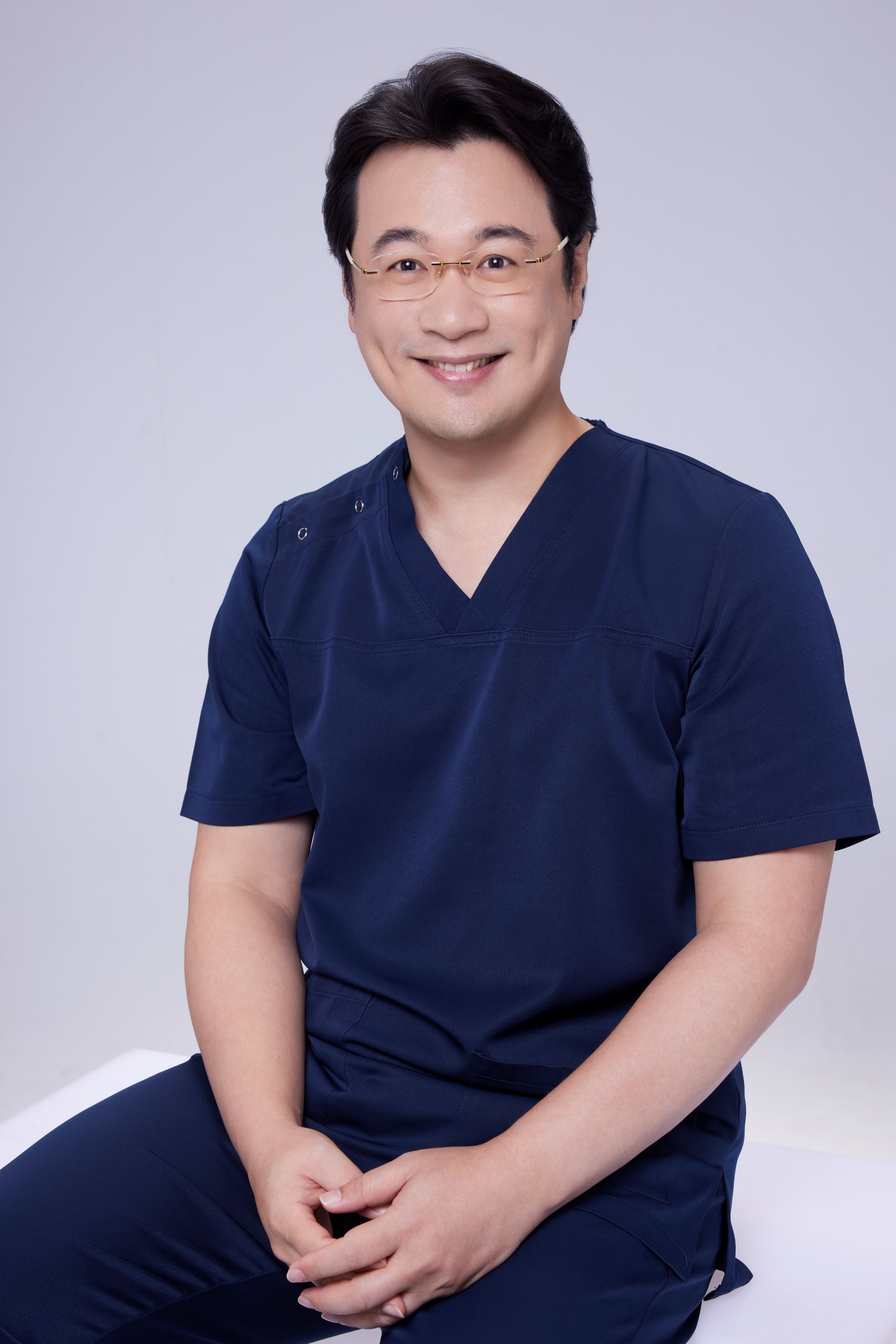
"For every surgery, I strive to achieve a good outcome through a small incision and refined technique. Minimally invasive surgery is not just a technique — it's a commitment of respect to every patient."
Want to learn more?
Schedule a consultation for professional evaluation and advice