Lip Filler Extraction and Reshaping: Precision Surgery That Preserves Aesthetics
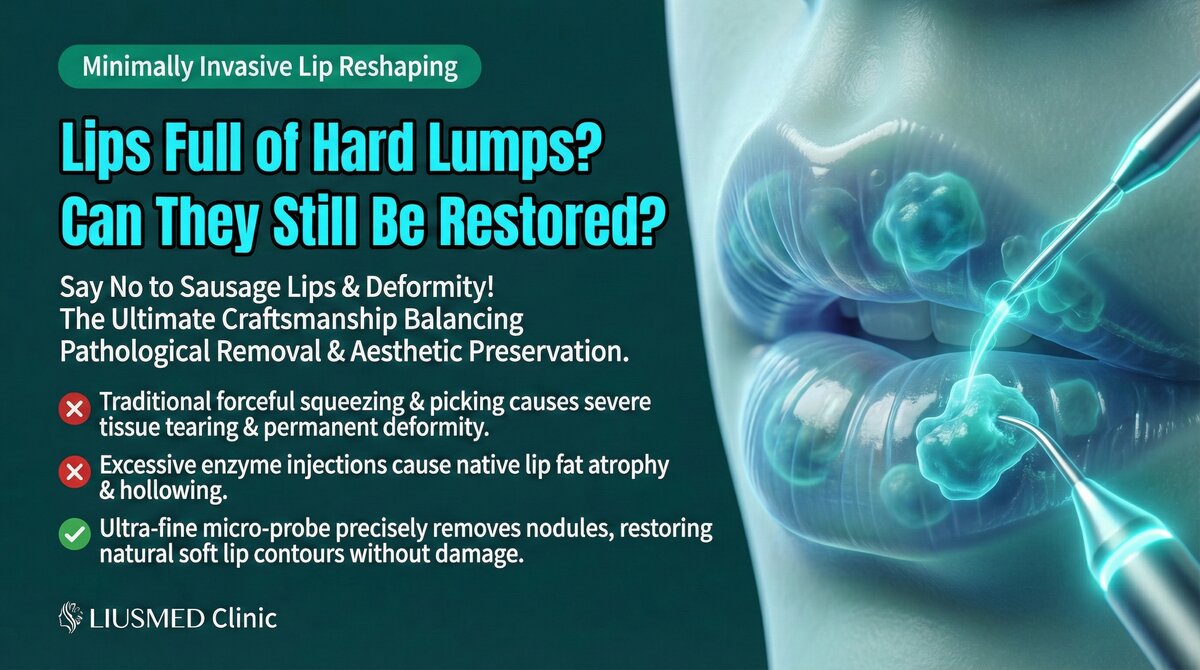
The Lip: Where Aesthetics and Function Must Both Be Preserved
The lips are among the most expressive features of the face and one of the fastest-growing areas for filler injection in recent years. However, lip filler complications are also on the rise — from unnatural "sausage lips" to nodules, asymmetry, and severe functional impairment.
The challenge of lip filler extraction lies in this: it is not enough to simply remove the material — post-extraction lip shape recovery must be considered from the start. This requires deep understanding of lip anatomy combined with precise ultrasound-guided technique.
Key Insight: The lips are among the most vascular areas on the entire face, with thin, sensitive mucosa. Extraction surgery must achieve a precise balance between "complete removal" and "natural lip contour preservation."
Unique Anatomy of the Lips
Lip Layered Structure
The lips have distinctly different structural characteristics from other facial areas:
| Structure | Characteristics | Surgical Significance |
|---|---|---|
| Skin/Vermilion mucosa | Extremely thin, semi-transparent | Filler color and texture may show through |
| Orbicularis oris muscle | Primary muscle encircling the lips | Damage affects dynamic lip function |
| Labial arteries | Superior and inferior labial arteries course within the muscle layer | Injury can cause significant hemorrhage |
| Sensory nerves | Densely distributed | Lips are extremely sensitive |
| Tubercle | Central upper lip prominence | Key structure for lip aesthetics |
| Cupid's bow | Natural arc of the upper lip | Defines lip contour |
Special Course of the Labial Arteries
| Artery | Course | Clinical Significance |
|---|---|---|
| Superior labial artery | Within the orbicularis oris, approximately 3–5 mm deep to mucosa | Operating depth must be precisely controlled |
| Inferior labial artery | Similar course to the superior labial artery | Ultrasound confirmation of position also required |
| Anastomotic branches | Rich anastomotic network with the contralateral artery | Injury to either side can cause significant bleeding |
Key Insight: The labial arteries run within the orbicularis oris muscle, and their position is not fixed. Color Doppler ultrasound can precisely localize artery position — a critical tool for safe operation.
Common Lip Filler Problems
| Problem Type | Presentation | Common Cause |
|---|---|---|
| Overfilling ("sausage lips") | Excessively swollen lips, loss of natural contour | Too much volume or repeated stacking |
| Lumps/Nodules | Palpable firm masses within the lip | Filler aggregation or fibrotic reaction |
| Asymmetry | Different thickness or shape on each side | Injection technique issues or filler migration |
| Loss of tubercle | Natural central upper lip prominence disappears | Filler covering or compressing the tubercle |
| Blurred Cupid's bow | Upper lip arc becomes indistinct | Filler migration into the Cupid's bow zone |
| White streaks / Tyndall effect | Visible white or blue streaks on the lip surface | Filler injected too superficially |
| Functional impairment | Difficulty speaking, kissing, or eating | Excessive filler affecting muscle function |
For more on lip filler complications, see Lip Filler Bubbles and Nodules.
The Role of Ultrasound in Lip Revision
Why Lip Revision Especially Needs Ultrasound
Ultrasound application in the lip area offers distinct advantages:
| Function | Description |
|---|---|
| Filler localization | Precisely displays filler distribution layer and extent within the lip |
| Artery tracking | Color Doppler shows the exact position of labial arteries in real time |
| Residual confirmation | Intraoperative real-time confirmation of extraction completeness |
| Symmetry assessment | Compares filler distribution between both sides |
| Texture evaluation | Differentiates liquid filler, aggregated masses, and fibrotic tissue |
Typical Ultrasound Appearances of Lip Filler
| Filler State | Ultrasound Features |
|---|---|
| Normal HA filler | Anechoic or hypoechoic homogeneous zone |
| Aggregation/Nodule | Well-defined hyperechoic mass |
| Fibrotic encapsulation | Hyperechoic capsule surrounding hypoechoic center |
| Diffusion/Migration | Irregularly distributed echogenicity changes |
Surgical Strategy for Lip Filler Extraction
Pre-Operative Precision Assessment
| Assessment Item | Method | Purpose |
|---|---|---|
| Filler type | History + ultrasound imaging | Determine extraction strategy |
| Filler distribution | High-frequency ultrasound scan | Confirm depth and extent |
| Labial artery position | Color Doppler | Plan safe pathway |
| Lip shape assessment | Clinical observation + photography | Set reshaping goals |
| Functional assessment | Dynamic muscle examination | Evaluate orbicularis oris function |
Key Surgical Execution Points
- Micro-incision design: Typically placed at the oral commissure or inner mucosal surface, virtually invisible after healing
- Continuous ultrasound guidance: Full-procedure ultrasound monitoring with real-time positional confirmation
- Segmental extraction: The lip is divided into four zones — upper central, upper lateral, lower central, lower lateral
- Arterial protection: Color Doppler continuously tracks labial artery position
- Real-time symmetry assessment: Appearance comparison between sides after each extraction segment
Key Insight: The greatest challenge in lip extraction is not the "removal" itself, but how to maintain natural lip shape afterward. This requires the physician to have aesthetic judgment, continuously evaluating overall appearance throughout the extraction process.
Lip Reshaping Considerations
Post-Extraction Lip Reconstruction Strategy
After filler removal, some patients may face lip shape changes. Reshaping strategies include:
| Scenario | Approach | Timing |
|---|---|---|
| Mild volume loss | Allow natural tissue recovery | 3–6 months |
| Focal depression | Precise small-volume supplementation (after tissue stabilization) | After 3–6 months |
| Blurred Cupid's bow | Precise Cupid's bow reconstruction | After tissue stabilization |
| Tubercle loss | Tubercle reconstruction injection | After tissue stabilization |
| Severe atrophy | Staged repair plan | Case-by-case assessment |
Principles for Preserving Lip Aesthetics
- Selective extraction: Not all filler necessarily needs to be removed — retain correctly positioned portions
- Staged extraction: Severe cases may be addressed in 2–3 sessions, allowing tissue to adapt gradually
- Protect key structures: Prioritize the integrity of the tubercle, Cupid's bow, and vermilion border
- Dynamic function preservation: Ensure orbicularis oris function is unaffected
- Personalized goals: Set final targets based on individual patient aesthetic preferences
Extraction Difficulty by Filler Type
| Filler Type | Difficulty | Special Challenges |
|---|---|---|
| HA (Hyaluronic acid) | Moderate | Can be dissolved but dissolution may be uneven |
| Collagen stimulators | High | High tissue integration, requires meticulous separation |
| Silicone/Silicone oil | Very high | Cannot be dissolved, diffuses extensively |
| PMMA | Very high | Permanent material, high tissue integration |
| Autologous fat | High | Must differentiate grafted fat from native tissue |
Post-Operative Care and Recovery
| Timeline | Expected Presentation | Care Recommendations |
|---|---|---|
| Days 1–3 | Significant swelling; lips may temporarily appear more swollen | Ice packs, soft foods, avoid wide mouth opening |
| Week 1 | Swelling reduced ~50% | Maintain oral hygiene |
| Week 2 | Most swelling resolved | Normal diet may resume |
| Month 1 | Basic recovery | Evaluate interim results |
| Month 3 | Tissue stabilized | Assess if lip supplementation is needed |
Conclusion: Lip Revision Is Where Aesthetics Meets Technique
Lip filler extraction is not merely a technical procedure — it is a delicate surgery that requires aesthetic vision. At Liusmed Clinic, we consider "safe extraction" and "aesthetic preservation" equally important goals. Through ultrasound-guided precision operation, we help patients regain natural, beautiful lip shape.
If you have lip filler concerns, contact Liusmed Clinic to arrange a consultation.
Related reading: Lip Filler Bubbles and Nodules, Filler Lump Extraction Technique, Filler Repair Evaluation Process
Related Services

Specialties
Credentials
- Kaohsiung Medical University, School of Medicine
- Attending Physician, Dermatology, Kaohsiung Chang Gung Memorial Hospital
- Attending Physician, Aesthetic Center, Kaohsiung Chang Gung Memorial Hospital
- Visiting Physician, Dermatology, Xiamen Chang Gung Hospital
- Visiting Physician, Aesthetic Center, Xiamen Chang Gung Hospital
"For every surgery, I strive to achieve a good outcome through a small incision and refined technique. Minimally invasive surgery is not just a technique — it's a commitment of respect to every patient."
Recovery after any procedure needs peer support too

Want to learn more?
Schedule a consultation for professional evaluation and advice