Complete Guide to Minimally Invasive Lipoma Surgery: <20% Ultra-Minimal Incision Technology
What is a Lipoma?
A lipoma is a benign tumor composed of mature fat cells and is one of the most common soft tissue tumors. It typically grows in the subcutaneous fat layer, feels soft and elastic like "soft dough," can be moved as a whole unit, and has clear boundaries.
Lipomas usually grow very slowly, potentially taking years to noticeably enlarge. They commonly occur in adults aged 40-60 and are frequently found on the trunk, limbs, and neck.
Should You See a Doctor for a Lipoma?
Many patients choose to observe when they first discover a lump, only seeking medical attention when it grows larger or becomes painful. Although lipomas are clinically mostly benign, we sincerely recommend not self-diagnosing.
When your body develops an unknown lump, you should let a professional physician make the diagnosis, as different diagnoses correspond to different treatment approaches. The doctor will help determine whether you need:
- Continued observation and monitoring
- Biopsy examination
- Prompt surgical removal
Doctors typically diagnose lipomas through manual palpation or a small biopsy, and results are quickly available.
Four Situations Requiring Immediate Medical Attention
| Warning Sign | Description |
|---|---|
| Rapid tumor growth | Noticeably enlarging in a short period |
| Pain or discharge | Discomfort or abnormal secretions |
| Skin color changes | Surface skin showing changes |
| Non-healing wound | Surface wound that won't heal |
⚠️ For any of these four situations, please seek medical attention promptly to ensure your health!
Are There Non-Surgical Treatment Options?
Limitations of Non-Surgical Treatments
| Method | Effect | Drawback |
|---|---|---|
| Local steroid injection | Can shrink the lipoma | Cannot cure completely, limited effectiveness |
| Minimally invasive liposuction | Only 2-3mm wound | Cannot completely remove, prone to recurrence |
Surgical Excision is the Fundamental Solution
The most fundamental approach is still excisional surgery, which provides the best chance of reducing recurrence.
Additionally, surgical removal is also recommended for:
- Angiolipoma: Lipoma containing vascular components
- Deep lipoma: Already compressing fascia or nerves, causing pain or even affecting nerve function
Liusmed <20% Ultra-Minimal Incision Technology
How small can the incision actually be
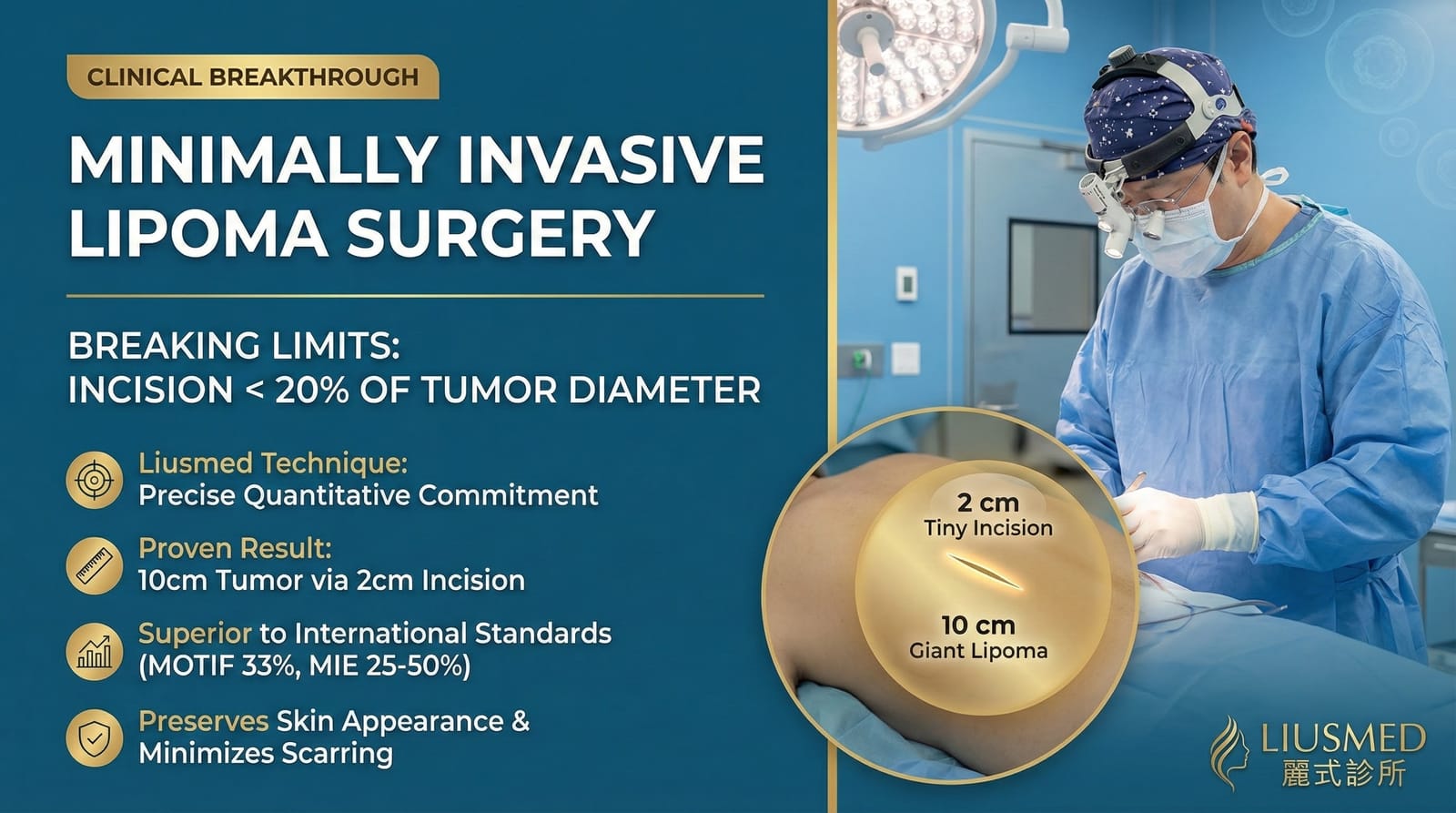
In the literature, minimally invasive techniques (MIE, MOTIF) set incision length at 25% to 50% of tumor diameter or long axis. In most of our cases the incision comes in under 20% of tumor diameter — but that is a clinical figure, not a promised one, and the next section explains why that distinction matters.
This means: A 10cm giant tumor requires only a 2cm minimal incision.
How the literature defines incision length
| Technique | How the literature defines incision length | Source |
|---|---|---|
| Linear incision extraction | About the diameter of the lipoma (100%) | JAMA Dermatol 2014 (PMID 25337780) |
| MIE (minimal incision extraction) | Defined as 25–50% of lipoma diameter | JAMA Dermatol 2014 (PMID 25337780) |
| MOTIF | One-third of the long axis, with a 1 cm floor | Biomed Res Int 2021 (PMID 34485512) |
| Our approach | Most cases land under 20% of tumor diameter | Our clinical experience; varies case to case |
Core Technical Advantages
Two things about that table need saying plainly, or it reads as a promise.
First, the 25–50% figure is how the questionnaire defined the option in that JAMA Dermatology study, not a measured result. It was a research letter: a survey sent to 233 dermatologists, 87 replies, and not one incision was measured. MOTIF's one-third is the same kind of thing — a pre-operative marking rule, and it carries an absolute 1 cm floor, so a 2 cm lipoma actually works out at 50%, not 33%.
Second, the study that did take a ruler to it came out less tidy. A 2023 Korean series measured 55 lipomas, starting every case at a one-third incision and extending only when needed. Twenty-one of them (38%) still ended up at two-thirds or more. Incision length was driven mainly by location — the head and neck being markedly different — and had no statistical relationship to tumor diameter or depth (PMID 37470263).
So I won't hand you a guaranteed number. What I can say is that in most cases we bring the incision in under 20% of tumor diameter, roughly 2 cm for a 10 cm lipoma. But location, depth and whether it has adhered all change the answer, and ultrasound before surgery is what tells us which one you are.
The technique
| Item | Detail |
|---|---|
| Incision target in most cases | Under 20% of tumor diameter |
| Typical figure | Around 2 cm for a 10 cm lipoma |
| Scarring | We work to preserve skin appearance and limit scarring; results vary with skin type and location |
Lipoma Surgery Process
The lipoma surgery process typically follows these steps:
| Step | Description |
|---|---|
| 1. Local Anesthesia | Anesthetic injection at the surgical site |
| 2. Skin Incision | Creating the smallest possible opening in the skin |
| 3. Tissue Separation | Precisely separating surrounding tissues |
| 4. Complete Removal | Removing the lipoma along with its outer capsule intact |
| 5. Wound Closure | Cosmetic suturing to minimize scarring |
Surgery Characteristics
- Short duration: Surgery time is typically brief
- No hospitalization: Most cases don't require hospitalization; same-day return home
- Earlier is better: Even small lipomas can be considered for early surgery, minimizing the wound and making post-operative care easier
💡 Recommendation: Don't wait until the lipoma grows larger—the earlier the treatment, the smaller the incision!
Ideal Candidates
Liusmed's ultra-minimal incision technology is particularly suitable for:
- ✅ Patients with giant lipomas (10cm or larger)
- ✅ Those pursuing optimal aesthetics with high expectations for minimal scarring
- ✅ Those concerned about recovery time who want to quickly return to daily activities
- ✅ Those previously told they need major surgery seeking better alternatives
Why Choose Liusmed?
A number we can actually give you
For giant lipomas over 10cm, the incision in most cases comes in around 2cm.
That is where tens of thousands of surgeries have landed, not a guaranteed figure. Location, depth and adhesion all move it.
Professional Advantages
| Item | Description |
|---|---|
| 20+ Years Experience | Over 20 years of accumulated minimally invasive surgery experience |
| Tens of Thousands of Cases | Successfully completed tens of thousands of lipoma surgeries |
| Precision Technique | A very small incision extraction method developed over many years |
| Closure | Cosmetic suturing, aimed at keeping scarring down |
Common questions
A lipoma is benign — do I really need to treat it?
Most lipomas are benign and grow slowly, but if left untreated they tend to keep enlarging over time. The larger the lump gets, the larger the incision needed to remove it. Treating it while it's still small keeps the wound small and the aftercare simpler.
Can steroid injections or liposuction take care of a lipoma?
A local steroid injection can shrink a lipoma somewhat, but it won't clear the whole thing. Minimally invasive liposuction leaves only a tiny wound, yet it's hard to clear the lipoma fully, so it tends to come back in the same spot. For complete removal, excisional surgery is still the main option.
When should I see a doctor promptly?
If the lump enlarges noticeably over a short time, starts to hurt or discharge fluid, the overlying skin changes color, or there's a surface wound that won't heal, don't keep watching it on your own — get it checked soon. In general it's better not to self-diagnose; a doctor can tell quickly through palpation or a small biopsy.
Will a large 10cm lipoma leave a big scar?
Not necessarily. A traditional elliptical excision uses an incision about as long as the tumor, but Liusmed's minimally invasive technique keeps the incision under 20% of the tumor's diameter. In practice that means a 10cm lipoma can be removed through an incision of roughly 2cm.
Does lipoma surgery need a hospital stay, and how long does it take?
Most lipoma procedures are done under local anesthesia plus gentle pain-relief anesthesia, usually don't take long, and let you go home the same day, so hospitalization generally isn't needed. The doctor numbs the area, makes a small incision, removes the lipoma together with its outer capsule, and closes with cosmetic sutures.
Conclusion
Although lipomas are benign tumors, if left untreated they may continue to grow, eventually requiring larger surgical incisions. Liusmed Clinic's <20% ultra-minimal incision technology means you don't have to choose between "health" and "aesthetics."
If you have any of the following concerns, please schedule a consultation:
- You have an unknown lump and want to confirm if it's a lipoma
- You've been diagnosed with a lipoma and want to learn about the smallest incision treatment options
- Your tumor is already large and you're worried about large traditional surgery incisions
- You pursue optimal aesthetics and have high expectations for minimal scarring
Related Links

Specialties
Credentials
- Kaohsiung Medical University, School of Medicine
- Attending Physician, Dermatology, Kaohsiung Chang Gung Memorial Hospital
- Attending Physician, Aesthetic Center, Kaohsiung Chang Gung Memorial Hospital
- Visiting Physician, Dermatology, Xiamen Chang Gung Hospital
- Visiting Physician, Aesthetic Center, Xiamen Chang Gung Hospital
"For every surgery, I strive to achieve a good outcome through a small incision and refined technique. Minimally invasive surgery is not just a technique — it's a commitment of respect to every patient."
Want to learn more?
Schedule a consultation for professional evaluation and advice