Lipoma Removal Recovery: 7-Day Wound Care Timeline
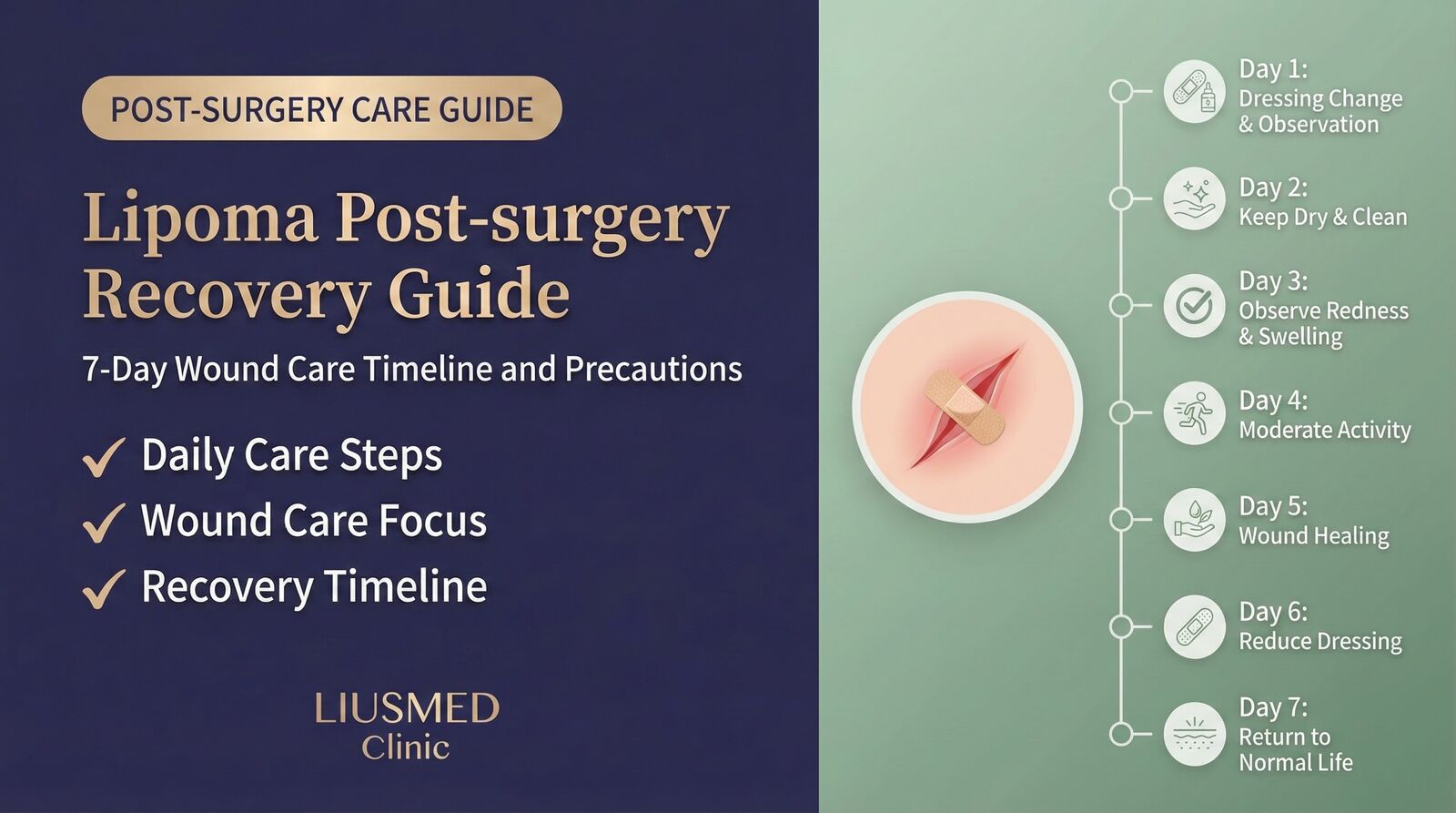
The First 7 Days: Your Recovery Roadmap
Post-operative wound care after lipoma surgery isn't complicated, but the first 7 days are the golden period for healing. Proper care during this time accelerates recovery, prevents infection, and minimizes scarring. This guide walks you through each day of your recovery.
7-Day Recovery Timeline
📅 Day 1 (Surgery Day)
| Item | Details |
|---|---|
| Wound Status | Covered with gauze, slight oozing normal |
| Activity Level | Normal walking OK, avoid strenuous activity |
| Pain Level | Mild to moderate after anesthesia wears off (1-3/10) |
| Medications | Take prescribed pain relievers and antibiotics as directed |
| Diet | Normal diet, avoid alcohol and spicy foods |
Key Reminders:
- ✅ Keep dressing dry
- ✅ Return for dressing change if gauze soaked more than half
- ❌ Do not remove dressing yourself
- ❌ Do not get wound wet
📅 Day 2
| Item | Details |
|---|---|
| Wound Status | Oozing should significantly decrease or stop |
| Swelling | Mild swelling around wound (normal) |
| Activity Level | Light daily activities, avoid lifting heavy objects |
| Pain Level | Decreasing (0-2/10) |
Care Focus:
- Continue keeping dressing dry
- May return for dressing change or change outer gauze as instructed
📅 Day 3
| Item | Details |
|---|---|
| Wound Status | Beginning to heal, less drainage |
| Swelling | Gradually decreasing |
| Activity Level | Can resume light work |
| Bathing | Can shower with waterproof dressing covering wound |
Showering Instructions:
- Apply waterproof transparent dressing completely covering wound
- Avoid prolonged hot water directly on wound area
- Check dressing immediately after—replace if wet inside
💡 Dr. Liu's Tip: "Make sure the waterproof dressing seals all edges. If you can't get a good seal, sponge bath instead."
📅 Days 4-5
| Item | Details |
|---|---|
| Wound Status | Scab forming, mild itching around wound |
| Swelling | Mostly resolved |
| Activity Level | Most daily activities OK |
| Note | Itching is normal healing—don't scratch |
Care Focus:
- Continue keeping wound clean and dry
- Ice pack for itching relief if needed
- Do not pick at scab
📅 Days 6-7 (Suture Removal)
| Item | Details |
|---|---|
| Wound Status | Wound basically healed |
| Follow-up | Doctor examines wound, removes sutures |
| Post-removal Care | Start scar prevention products |
After Suture Removal:
- Day of removal: Doctor applies steri-strips
- Weeks 1-2: Change steri-strips every 3-5 days
- Weeks 2-4: Switch to silicone scar sheets or gel
Step-by-Step Wound Care
If instructed to change dressings at home, follow these steps:
Supplies Needed
- Sterile saline or cooled boiled water
- Sterile cotton swabs or gauze
- Antibiotic ointment (if prescribed)
- New sterile gauze
- Medical tape
Dressing Change Steps
- Wash hands thoroughly with soap
- Remove old dressing gently—wet with saline if stuck
- Clean wound using cotton swab with saline, wiping from center outward
- Inspect wound for redness, swelling, or unusual discharge
- Apply ointment in thin layer if prescribed
- Cover with new gauze and secure with tape
⚠️ Alert: If you notice significant redness, heat, pus, or increasing pain, contact your doctor immediately.
Warning Signs: When to Seek Help
Return Immediately If You Notice 🚨
| Warning Sign | Possible Cause |
|---|---|
| Bleeding that won't stop after 24 hours | May need additional treatment |
| Expanding redness around wound | Possible infection |
| Yellow/green pus from wound | Infection |
| Fever over 38°C (100.4°F) | Possible systemic infection |
| Wound opening up | May need re-suturing |
Normal Findings (Don't Worry)
- Slight redness immediately around incision (within 1-2 cm)
- Small amount of clear/light yellow drainage
- Mild swelling and bruising
- Itching around wound
Scar Care: After Suture Removal
Using Steri-Strips
- Direction: Apply perpendicular to incision to reduce tension
- Frequency: Change every 3-5 days or when dirty
- Duration: Use for 1-3 months
Using Silicone Sheets/Gel
- Start timing: 2 weeks after sutures removed, when wound fully closed
- Wear time: At least 12 hours daily
- Duration: 3-6 months for best results
💡 Dr. Liu's Advice: "Minimal incision wounds are already small. With basic care, most patients won't need expensive scar treatments. But if you have a history of keloids, continue silicone products longer."
Activity Guidelines
✅ What You Can Do
| Activity | When |
|---|---|
| Normal walking, light activity | Day 1 |
| Light office work | Days 2-3 |
| Showering with waterproof cover | Day 3 |
| Light exercise (walking) | Day 7 |
| Swimming, baths | Day 14 |
| Strenuous exercise | Days 14-21 |
❌ What to Avoid
| Activity | Reason |
|---|---|
| Getting wound wet (first 3 days) | Infection risk |
| Heavy exercise (first 2 weeks) | May cause wound to open |
| Smoking | Impairs wound healing |
| Alcohol | Increases bleeding and swelling |
| Picking at scab | May cause scarring |
Frequently Asked Questions
Q1: My wound is itchy—can I scratch it?
A1: Absolutely not! Itching is a normal sign of healing as nerves repair. Use ice pack or gentle patting to relieve itching, but never scratch the wound.
Q2: Can I drink coffee after surgery?
A2: Moderate coffee is fine after the first 24 hours. Caffeine may slightly increase bleeding risk immediately after surgery, so avoid it on surgery day. After that, normal consumption is OK.
Q3: Is bruising around the wound normal?
A3: Yes, completely normal. Bruising is from minor bleeding under the skin. It will change from purple-red to yellow-green and disappear in 1-2 weeks.
Q4: What should I eat to help healing?
A4: Balanced diet is most important. You can increase:
- Protein: Meat, fish, eggs, legumes (tissue repair)
- Vitamin C: Fruits, vegetables (collagen synthesis)
- Zinc: Seafood, nuts (wound healing)
Q5: When should I come back to the clinic?
A5: Besides your scheduled suture removal, return early if you experience:
- Persistent or increasing bleeding
- Expanding redness
- Fever or pus
- Severe increasing pain
Recovery Timeline Summary
| Milestone | Minimal Incision | Traditional Surgery |
|---|---|---|
| Normal activity | Day 1 | Days 3-5 |
| Showering | Day 3 | Days 5-7 |
| Suture removal | Day 7 | Days 10-14 |
| Exercise | Day 14 | Days 21-28 |
| Scar maturation | 1-3 months | 3-6 months |
Related Reading
- Lipoma Surgery: Minimal Incision vs Traditional
- Complete Guide to Lipoma Minimal Incision Surgery
- How to Prevent Post-Surgical Scar Formation
About the Author
Dr. Ta-Ju Liu
- Current Position: Director, Liushi Clinic
- Specialties: Minimal incision surgery (lipoma, cyst), hyperhidrosis surgery, thread lifting
- Experience:
- 15+ years of clinical minimal incision surgery experience
- Over 10,000 successful minimal incision cases
- Board-certified dermatologist
- Philosophy: "Post-operative care is just as important as the surgery itself. We provide comprehensive follow-up to ensure every patient recovers smoothly."
Related Services

Specialties
Credentials
- Kaohsiung Medical University, School of Medicine
- Attending Physician, Dermatology, Kaohsiung Chang Gung Memorial Hospital
- Attending Physician, Aesthetic Center, Kaohsiung Chang Gung Memorial Hospital
- Visiting Physician, Dermatology, Xiamen Chang Gung Hospital
- Visiting Physician, Aesthetic Center, Xiamen Chang Gung Hospital
"For every surgery, I strive to achieve a good outcome through a small incision and refined technique. Minimally invasive surgery is not just a technique — it's a commitment of respect to every patient."
Want to learn more?
Schedule a consultation for professional evaluation and advice