Lipoma Surgery: Minimal Incision vs Traditional Compared
The Key Question: How Big Will the Scar Be?
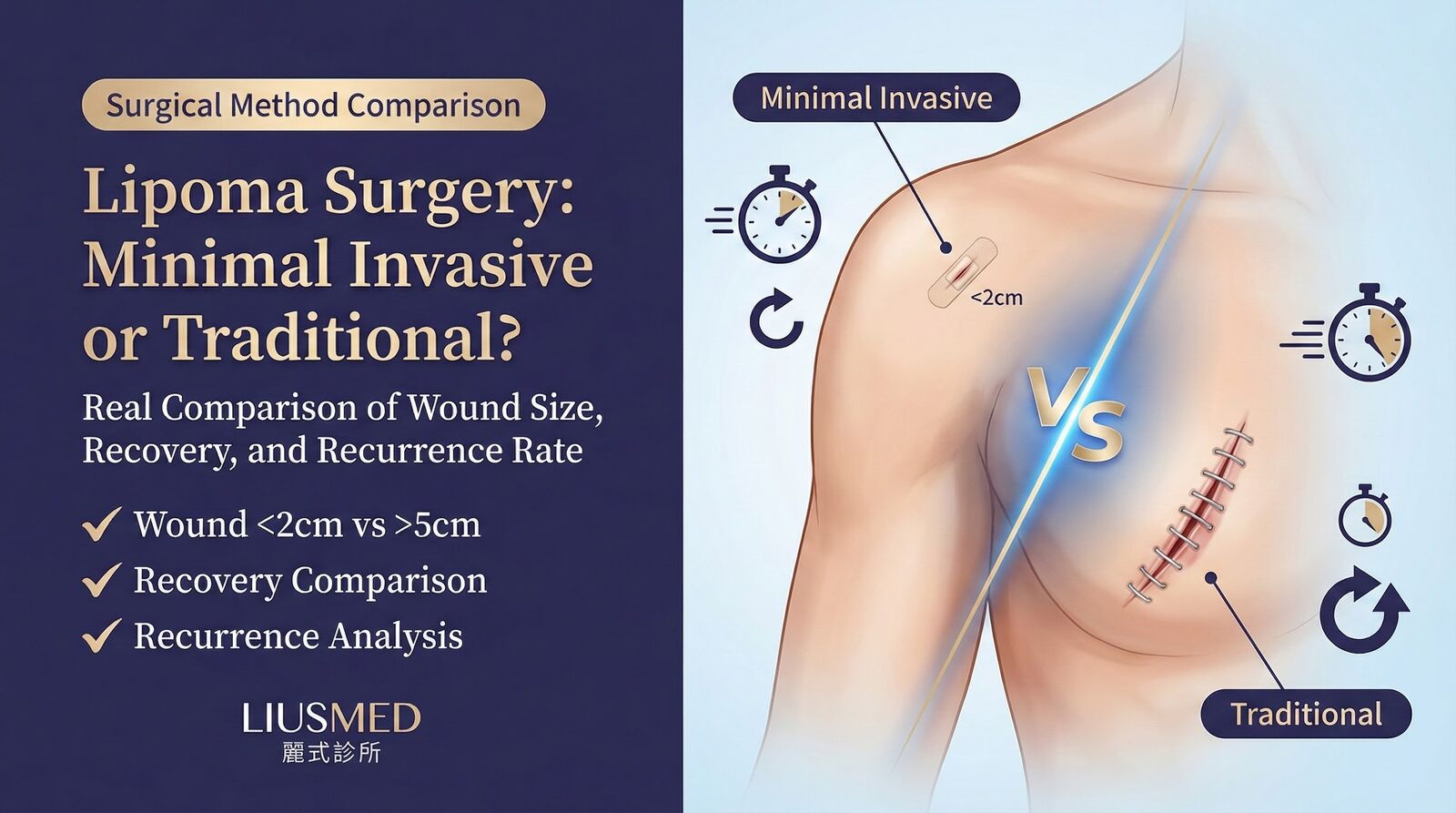
For patients considering lipoma removal, the most common concern is: "How big will the scar be?" Traditional surgery requires an incision 2-3 times the lipoma size, while minimal incision surgery can remove the same lipoma through a wound smaller than the tumor itself. This article provides a comprehensive comparison to help you make an informed decision.
Complete Comparison Table
| Comparison | Traditional Surgery | Minimal Incision Surgery | Liusmed <20% Ultra-Minimal |
|---|---|---|---|
| Incision Size | 2-3x lipoma diameter | ≤ lipoma diameter | < 20% of diameter |
| Example (3cm lipoma) | 6-9 cm incision | < 2 cm incision | about 0.6 cm |
| Anesthesia | Local or general | Local only | Local tumescent |
| Surgery Time | 30-60 minutes | 15-30 minutes | 15-30 minutes |
| Recovery Period | 2-4 weeks | 5-7 days | 3-5 days |
| Suture Removal | 10-14 days | 7 days | 7 days |
| Scarring | More visible | Minimal | In proportion to the incision |
| Recurrence Rate | Literature cites about 1–2%¹ | Published studies followed patients for only 6–9 months — too short to show a long-term recurrence rate² | Uncommon over years of clinical follow-up; the key is removing the capsule intact |
| Cost | Lower | Higher | Higher |
¹ Review figure cited by Copeland-Halperin et al. 2015 (PMID 25694827). ² Park et al. 2021 (PMID 34485512); Oh et al. 2026 (PMID 41899370). Lipomas grow slowly, so short follow-up underestimates recurrence; no comparative study has shown that any one technique recurs less.
Traditional Surgery: The Conventional Approach
Surgical Principle
Traditional lipoma surgery follows a "see it all, remove it all" principle. The surgeon makes an incision large enough to expose the entire lipoma, then removes it as a whole unit.
Procedure Steps
- Mark incision line (2-3x lipoma diameter)
- Administer local or general anesthesia
- Cut through skin, subcutaneous tissue, and capsule
- Expose and remove entire lipoma
- Hemostasis and wound irrigation
- Layered closure with sutures
Advantages
| Advantage | Description |
|---|---|
| Complete visualization | Surgeon sees entire lipoma |
| Lower technical demand | Standard surgical technique |
| Lower cost | Standard procedure pricing |
Disadvantages
| Disadvantage | Description |
|---|---|
| Large scar | 2-3x lipoma size |
| Longer recovery | 2-4 weeks |
| More pain | Larger wound area |
| Higher infection risk | Larger wound exposure |
Minimal Incision Surgery: The Modern Approach
Surgical Principle
Minimal incision surgery uses specialized techniques to remove the entire lipoma through an incision smaller than the tumor itself—what we call "1:1 or smaller" extraction.
How Is This Possible?
| Technique | Description |
|---|---|
| Tumescent anesthesia | Fluid injection separates lipoma from surrounding tissue |
| Capsule manipulation | Lipoma is mobilized within its capsule |
| Fragmentation extraction | Lipoma is removed in controlled pieces |
| Specialized instruments | Designed for small-incision work |
How Small: the Sub-20% Incision Ratio
The literature sets its own thresholds. MIE (minimal incision extraction) is defined as 25–50% of lipoma diameter (JAMA Dermatol 2014, PMID 25337780), and MOTIF takes one-third of the long axis, with a 1 cm floor (Biomed Res Int 2021, PMID 34485512).
Liusmed's refined technique keeps the incision under 20% of tumor diameter, which is smaller than those literature ranges. For a 5 cm lipoma that means an incision under 1 cm; for a 10 cm one, about 2 cm.
Whether that ratio is achievable in a given case depends on the site, depth and consistency of the lipoma, and is decided at in-person assessment with ultrasound. For how the literature defines these thresholds, and why the published numbers are not directly comparable with one another, see the complete guide to lipoma minimal incision surgery.
Procedure Steps
- Precise preoperative marking
- Tumescent local anesthesia
- Minimal incision (typically < 2 cm)
- Create subcutaneous tunnel
- Mobilize lipoma within capsule
- Extract through small opening
- Verify complete removal
- Aesthetic wound closure
Advantages
| Advantage | Description |
|---|---|
| Minimal scarring | Incision ≤ lipoma size |
| Fast recovery | Return to normal in 5-7 days |
| Less pain | Smaller wound = less discomfort |
| Local + gentle pain-relief anesthesia | No general anesthesia risks |
| Lower recurrence | Complete capsule removal |
Disadvantages
| Disadvantage | Description |
|---|---|
| Higher cost | Specialized technique |
| Requires expertise | Not all surgeons trained |
| Size limitations | Very large lipomas may need traditional approach |
Wound Size: Real-World Comparison
Example: 5 cm Lipoma
| Approach | Incision Length | Visible Scar |
|---|---|---|
| Traditional | 10-15 cm | Very noticeable |
| Minimal Incision | 3-4 cm | Easily hidden |
Example: 3 cm Lipoma
| Approach | Incision Length | Visible Scar |
|---|---|---|
| Traditional | 6-9 cm | Noticeable |
| Minimal Incision | 1.5-2 cm | Nearly invisible |
💡 Dr. Liu's Note: "For a lipoma that fits in your palm, why leave a scar the length of your finger? Minimal incision surgery changes this equation entirely."
Recovery Time Comparison
Traditional Surgery Recovery
| Timeline | Status |
|---|---|
| Day 1-3 | Moderate pain, limited activity |
| Day 4-7 | Pain decreasing, still restricted |
| Week 2 | Sutures removed, careful activity |
| Week 3-4 | Gradual return to normal |
| Month 2-3 | Scar maturation |
Minimal Incision Recovery
| Timeline | Status |
|---|---|
| Day 1 | Mild discomfort, normal walking |
| Day 2-3 | Minimal pain, light activity OK |
| Day 4-5 | Most normal activities resume |
| Day 7 | Sutures removed |
| Week 2-3 | Full recovery |
Recurrence Rates: The Critical Factor
Why Lipomas Recur
Recurrence is generally attributed to capsule remnants remaining. The lipoma capsule is a thin membrane surrounding the fatty tissue; if any part stays behind, the lipoma may regrow. This is a mechanistic inference — no study has directly compared intact versus incomplete capsule removal.
Recurrence by Approach
| Approach | Recurrence Rate | Reason |
|---|---|---|
| Traditional | Literature cites about 1–2% (PMID 25694827) | Usually complete, but trauma can leave fragments |
| Minimal Incision | Too early to tell — published series followed only 6–9 months (PMID 34485512, 41899370) | Capsule preserved and removed intact |
| Aspiration/Liposuction | Mixed evidence (see below) | Only removes contents; capsule may remain |
⚠️ Important: Aspiration or liposuction removes the contents but not necessarily the capsule. The evidence is mixed: several small series followed for 1 to 6 years found recurrence to be rare, while a 1992 study of giant lipomas found a clearly higher share of recurrences after liposuction than after excision (PMID 1414141).
Why Liposuction Tends to Leave Residue
Dr. Ta-Ju Liu's clinical view: liposuction works by passing a cannula back and forth under the skin without seeing the tumor's boundary — in effect, a blind technique. Any lipomatous tissue or capsule left behind can slowly grow back into a lump. The literature supports this in several ways:
- Cannot see, cannot confirm: the plastic surgery literature describes suction lipectomy as "an efficient, albeit blind, method," noting that larger or poorly encapsulated tumors carry a greater recurrence risk "probably because of an unrecognized residua" (Hallock 1995, PMID 7702298).
- The capsule is easily breached: because the capsule is fibrous, "its violation is more likely with suction technique and may result in an inadequate resection, possibly leading to recurrence" (Al-Basti 2002, PMID 12016495).
- Residual tissue contains cells that can regrow: one study found abundant stem-cell-marked, lipoma-derived cells in the hard tissue left after liposuction, which the authors suggest may play a role in recurrence (Xu 2013, PMID 23772488).
- A comparative report: in 30 patients with giant lipomas, one-year follow-up showed "a high percentage of recurrences after liposuction but only one after excision" (Raemdonck 1992, PMID 1414141).
A point that is often overlooked is pathology: aspirated tissue is fragmented and cannot be fully examined. A few tumors that look like lipomas are actually liposarcomas, and aspirating them can miss the diagnosis (Al-Basti 2002; Voulliaume 2003, PMID 12837640).
To be clear, most of this comes from small studies and author commentary; no large study gives a definitive recurrence rate for liposuction. Some teams remove the capsule through the same small incision after liposuction and, over long follow-up, have not reported a single recurrent lipoma (PMID 12016495, 25694827) — which underlines that the key is whether the capsule comes out completely. That is exactly why Liusmed dissects the capsule out intact under direct vision.
Cost-Benefit Analysis
Short-Term Costs
| Factor | Traditional | Minimal Incision |
|---|---|---|
| Surgery fee | Lower | Higher |
| Anesthesia | May need general | Local only |
| Facility fee | Standard | Standard |
Long-Term Considerations
| Factor | Traditional | Minimal Incision |
|---|---|---|
| Time off work | 1-2 weeks | 2-3 days |
| Scar revision | May be needed | Rarely needed |
| Recurrence treatment | Possible | Very rare |
| Patient satisfaction | Good | Excellent |
Who Should Choose Which Approach?
Choose Traditional Surgery If:
- Very large lipoma (> 10 cm)
- Deep intramuscular lipoma
- Suspected malignancy requiring wide margins
- Cost is primary concern
- No access to trained specialist
Choose Minimal Incision If:
- Concerned about scarring
- Located in visible area
- Quick recovery needed
- Multiple lipomas
- Previously had traditional surgery with poor scarring
Common Questions FAQ
Q1: Can all lipomas be removed with minimal incision?
A1: Most lipomas can be removed minimally, but some exceptions include:
- Very large lipomas (> 15 cm)
- Deep intramuscular lipomas
- Suspected liposarcoma
- Previous surgery with extensive scarring
During consultation, the surgeon will assess whether minimal incision is appropriate.
Q2: Is the lipoma completely removed with such a small incision?
A2: Yes. The key is technique, not incision size. The lipoma is mobilized within its capsule and extracted whole or in controlled pieces. Complete removal is verified before closing.
Q3: Why don't all doctors offer minimal incision surgery?
A3: Minimal incision surgery requires:
- Specialized training
- Specific instruments
- Considerable experience
- Different surgical mindset
Not all surgeons have learned these techniques.
Q4: Will insurance cover minimal incision surgery?
A4: Coverage varies by:
- Insurance plan
- Medical necessity
- Provider policies
- Country/region
Check with your insurance and clinic for specifics.
Q5: How do I find a qualified minimal incision surgeon?
A5: Look for:
- Board certification in dermatology or plastic surgery
- Documented experience with minimal incision techniques
- Before/after photos of similar cases
- Patient reviews and testimonials
Conclusion
| If You Prioritize... | Choose... |
|---|---|
| Minimal scarring | Minimal Incision |
| Fast recovery | Minimal Incision |
| Lower recurrence | Minimal Incision |
| Lowest cost | Traditional |
| Very large lipoma | Traditional |
Related Reading
- Lipoma Post-Op Recovery Guide: 7-Day Wound Care Timeline
- Complete Guide to Lipoma Minimal Incision Surgery
- Lipoma vs Cyst: How to Tell the Difference
About the Author
Dr. Ta-Ju Liu
- Current Position: Director, Liushi Clinic
- Specialties: Minimal incision surgery (lipoma, cyst), hyperhidrosis surgery, thread lifting
- Experience:
- 15+ years of clinical minimal incision surgery experience
- Over 10,000 successful minimal incision cases
- Board-certified dermatologist
- Philosophy: "A good surgery should leave minimal trace. I believe patients deserve results that not only remove the problem but also preserve their appearance."
Related Services

Specialties
Credentials
- Kaohsiung Medical University, School of Medicine
- Attending Physician, Dermatology, Kaohsiung Chang Gung Memorial Hospital
- Attending Physician, Aesthetic Center, Kaohsiung Chang Gung Memorial Hospital
- Visiting Physician, Dermatology, Xiamen Chang Gung Hospital
- Visiting Physician, Aesthetic Center, Xiamen Chang Gung Hospital
"For every surgery, I strive to achieve a good outcome through a small incision and refined technique. Minimally invasive surgery is not just a technique — it's a commitment of respect to every patient."
Want to learn more?
Schedule a consultation for professional evaluation and advice