Realistic Expectations for Filler Repair: What Can Be Achieved and What Cannot
Why Discussing Realistic Expectations Matters
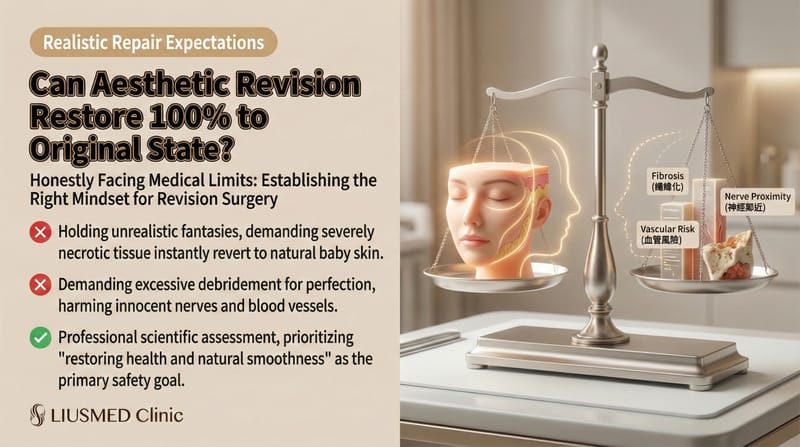
In my repair clinic, I find that many patients arrive with one of two extremes: "I expect everything to go back to normal" or "I feel it is completely hopeless." The truth usually lies somewhere in between — repair can significantly improve most issues, but it has objective limitations.
Setting realistic expectations is not about dampening hope. It is about ensuring you make decisions with full understanding. This is also the foundation for successful treatment.
What Repair Can Typically Achieve
High-Success Improvements
| Problem Type | Achievable Result | Success Assessment |
|---|---|---|
| Filler lumps | Noticeably improved texture and appearance after removal | High |
| Filler migration | Removal of displaced filler, restored contour | High |
| Over-injection | Removal of excess filler, reduced fullness | High |
| Asymmetry | Improved symmetry through selective extraction | Medium-high |
| Tyndall effect | Improvement after removing superficial HA | High |
| Pressure/discomfort | Usually immediate relief after extraction | High |
Situations Requiring Multiple Treatments
| Situation | Why Multiple Sessions | Approximate Number |
|---|---|---|
| Multi-layer injections | Different layers need separate treatment | 2-3 sessions |
| Large-volume filler | Removing too much at once risks tissue damage | 2-4 sessions |
| Permanent fillers | Deeply integrated with tissue, requires staged removal | 2-5 sessions |
| With granuloma | Inflammation must be controlled before extraction | Variable |
| Multiple areas | May need area-by-area treatment | Depends on number |
Key Insight: "Multiple treatments" does not mean "treatment failure." For complex cases, staged treatment is actually the safer and more responsible approach. Each session brings you closer to the ultimate goal.
Objective Limitations of Repair
Conditions That Cannot Be Fully Reversed
Honestly, some conditions are beyond what current medical technology can completely resolve:
| Condition | Reason for Limitation | What Can Be Done |
|---|---|---|
| Tissue atrophy | Long-term filler compression caused tissue damage | Compensate with alternatives (e.g., fat grafting) |
| Permanent scarring | Scarring from prior surgery or inflammation | Improve but cannot fully eliminate |
| Lost skin elasticity | Chronically stretched skin may not fully retract | Combine with skin-tightening treatments |
| Nerve damage | Sensation changes from prior injection | Some may improve; some may persist |
| Vascular damage sequelae | Tissue necrosis that already occurred | Scar treatment and reconstruction |
Factors That Influence the Final Outcome
| Factor | How It Affects Results |
|---|---|
| Filler type | Permanent fillers are harder to address than absorbable ones |
| Time since injection | Earlier treatment yields better results, but late treatment still helps |
| Filler volume | Larger volume and wider area require staged treatment |
| Tissue condition | Presence of inflammation, infection, or fibrosis |
| Individual constitution | Healing ability, scar tendency, age |
| Post-operative compliance | Whether care instructions are followed |
How to Set Realistic Expectations
The Shared Discussion Between Physician and Patient
At our clinic, pre-operative consultations include explicit outcome discussions:
| Discussion Topic | Details |
|---|---|
| Best outcome | What might be achieved under ideal conditions |
| Realistic outcome | The improvement most patients can expect |
| Minimum outcome | The least improvement achievable even in less ideal circumstances |
| What cannot be achieved | Honest disclosure of unrealistic expectations |
| Risk discussion | Possible complications and how they would be managed |
Questions to Ask Yourself
During consultation, consider these questions:
| Question | Realistic Answer Direction |
|---|---|
| Do I expect to look exactly like before injection? | Possible to get close, but usually not identical |
| Do I expect one surgery to fix everything? | Possible for simple cases; complex cases usually need multiple |
| Do I expect absolutely no scarring? | Minimally invasive scars are tiny but not zero |
| Do I expect to see the final result immediately? | Swelling must resolve first (typically 1-3 months) |
| Do I expect zero risk? | All surgery carries risk, but it can be minimized |
Key Insight: A responsible physician will tell you "how much improvement to expect," not guarantee "perfection." If a physician promises to make you "completely normal again" with "zero risk," that should be a cause for caution rather than reassurance.
Repair Expectations by Filler Type
| Filler Type | Repair Difficulty | Expected Outcome | Notes |
|---|---|---|---|
| Hyaluronic acid | Lower | Most can be well improved | Hyaluronidase may be tried first |
| Collagen stimulators | Moderate | Improvement possible, may need multiple sessions | Stimulated collagen cannot be removed |
| PAAG/Amazingel | Higher | Significant improvement; complete clearance difficult | Multiple surgeries may be needed |
| Silicone | Higher | Improvement possible; complete removal depends on case | Integration degree affects outcome |
| Autologous fat | Moderate | Improvement possible; surviving fat harder to fully remove | Ultrasound guidance improves results |
Long-Term Outlook After Repair
What Most Patients Actually Experience
Based on our clinical experience:
| Improvement Level | Proportion | Patient Satisfaction |
|---|---|---|
| Significant (80%+) | About 60-70% of patients | Very satisfied |
| Notable (50-80%) | About 20-25% of patients | Satisfied |
| Partial (30-50%) | About 5-10% of patients | Acceptable |
| Limited (below 30%) | Few complex cases | Requires further treatment |
Room for Continued Improvement
Even when initial surgery shows limited improvement, further progress is possible:
- Second extraction surgery
- Adjunctive treatments (laser, injection, etc.)
- Rebuilding plan (fat grafting, etc.)
- Natural improvement over time
Conclusion: Understanding Is the Best Preparation
Setting realistic expectations is not giving up hope — it is facing the problem with the most practical mindset. When you understand what repair can and cannot do, you can make the best decisions and maintain a positive outlook throughout recovery.
To learn about the specific repair process, read our repair evaluation process and post-extraction rebuilding plan.
Most importantly, every situation is unique. Your specific repair expectations need to be determined through actual consultation with ultrasound examination and clinical assessment. Book a consultation so we can evaluate your situation together.
Also see our minimally invasive extraction technique to understand what the most advanced extraction methods can achieve.
Want to hear about real repair outcomes? On the FillerRescue Forum, many patients share their before-and-after experiences to help set realistic expectations. You can also visit Dr. Liu's Community for more case studies.
Related Services
Specialties
Credentials
- Kaohsiung Medical University, School of Medicine
- Attending Physician, Dermatology, Kaohsiung Chang Gung Memorial Hospital
- Attending Physician, Aesthetic Center, Kaohsiung Chang Gung Memorial Hospital
- Visiting Physician, Dermatology, Xiamen Chang Gung Hospital
- Visiting Physician, Aesthetic Center, Xiamen Chang Gung Hospital
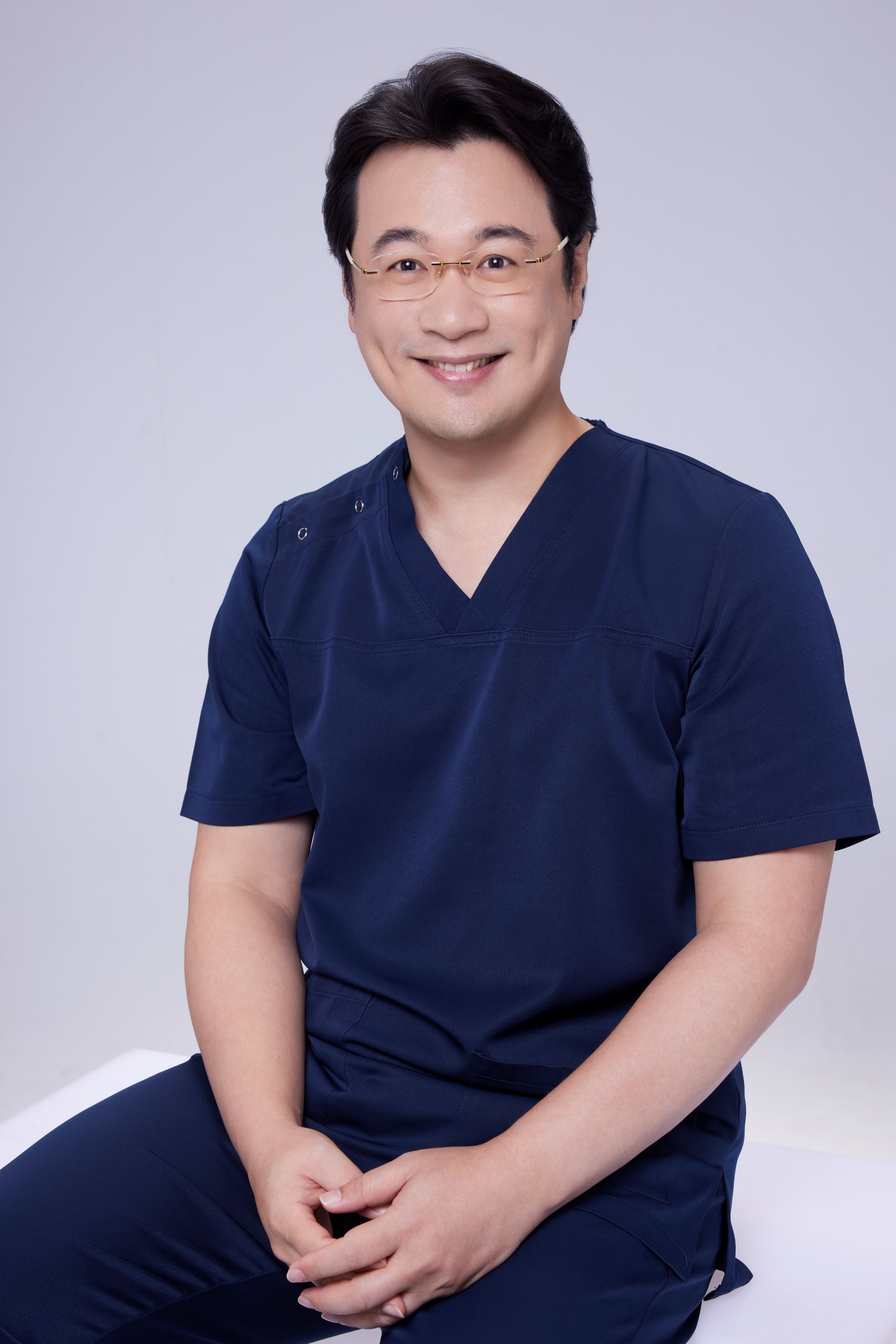
"For every surgery, I strive to achieve a good outcome through a small incision and refined technique. Minimally invasive surgery is not just a technique — it's a commitment of respect to every patient."
Recovery after any procedure needs peer support too

Want to learn more?
Schedule a consultation for professional evaluation and advice