How Long After Filler Removal Can You Safely Re-Inject?
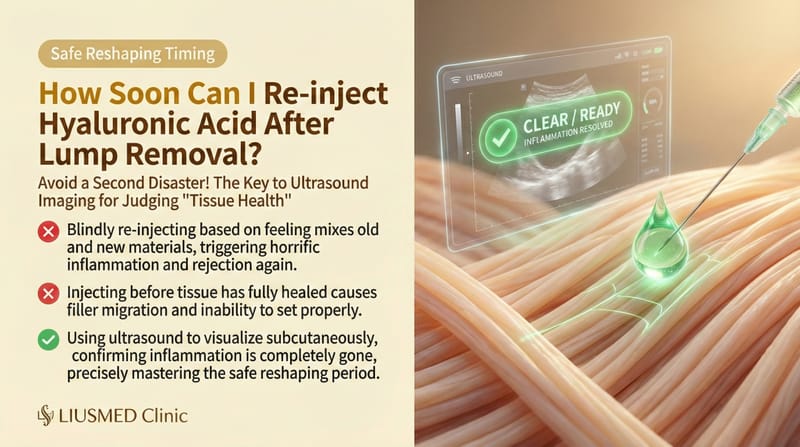
Can I Get Injections Again After Removal?
This is one of the most frequently asked questions in my clinic. After experiencing filler complications and successful extraction, many patients want to improve their appearance but fear repeating the same experience. This ambivalence is entirely understandable.
The answer is: under the right conditions and with professional judgment, re-injection is feasible. But the key lies in "when" and "how" — not in rushing to fill the gap.
Why You Cannot Re-Inject Immediately
Risks of Immediate Re-Injection
| Risk | Explanation |
|---|---|
| Tissue instability | Post-extraction tissue is still repairing and remodeling |
| Residual inflammation | Even if the surface looks healed, deep inflammation may persist |
| Inaccurate assessment | True volume needs cannot be determined until swelling fully resolves |
| Increased infection risk | Healing tissue is more sensitive to foreign materials |
| Immune sensitization | Tissue that had a foreign body reaction may react more strongly to new injections |
Key Insight: Waiting patiently is not wasting time — it is building a solid foundation for your next treatment. Rushing may create problems more complex than the original issue.
Safe Re-Injection Timing Guidelines
Minimum Waiting Periods
| Situation | Minimum Wait | Ideal Wait |
|---|---|---|
| Simple HA filler removal | 3 months | 4-6 months |
| Collagen stimulator removal | 4-6 months | 6-12 months |
| Permanent filler removal | 6+ months | 9-12 months |
| With infection or granuloma | 6-12 months | 12+ months |
| Multiple prior surgeries | 6-12 months | Case-dependent, physician evaluation needed |
Criteria for Re-Injection Readiness
All of the following conditions should be met before considering re-injection:
| Criterion | Assessment Method |
|---|---|
| Tissue fully stabilized | Soft to touch, no lumps or swelling |
| Ultrasound confirmation | No residual filler or inflammatory activity |
| Healthy skin condition | No active scarring or skin issues |
| Psychological readiness | Comfortable with the decision, not anxiety-driven |
| Realistic expectations | Understanding of possible outcomes and limitations |
Key Insight: Ultrasound examination is an objective tool for determining whether tissues are truly stable. Appearance and palpation alone may miss deeper issues. This is why we always perform ultrasound follow-up before re-injection.
Product Selection Principles for Re-Injection
Choosing Safe Fillers
Patients who have experienced complications should be especially careful when selecting products for re-injection:
| Principle | Details |
|---|---|
| Choose reversible products | Prioritize hyaluronic acid or other degradable/dissolvable products |
| Avoid permanent fillers | Silicone, PAAG, and other permanent products are not recommended |
| Choose certified brands | Use products approved by health regulatory authorities |
| Understand product properties | Different HA brands have different physical characteristics |
| Consider alternatives | Autologous fat grafting may be a safer option |
Product Recommendations by Area
| Area | Recommended Product Type | Notes |
|---|---|---|
| Tear trough / periorbital | Low-viscosity HA | High-risk area requiring extra caution |
| Cheeks / midface | Medium-high viscosity HA or fat | Avoid excess volume |
| Nose | Consider surgical alternatives | Higher vascular risk |
| Chin / jawline | Medium-high viscosity HA | Moderate volume approach |
| Forehead / temples | HA or autologous fat | Deep injection needs ultrasound guidance |
Advantages of Ultrasound-Assisted Re-Injection
Why We Recommend Injection Under Ultrasound Guidance
| Advantage | Explanation |
|---|---|
| Real-time visualization | See exactly which tissue layer receives the filler |
| Vascular avoidance | Reduces risk of vascular occlusion |
| Residual check | Final confirmation of no remaining filler before injecting |
| Precise dosing | More accurate control of volume and placement |
| Post-injection verification | Immediate confirmation of filler distribution |
Risk Management Strategies
Safety Rules for Re-Injection
"Small amounts, multiple sessions" is the most important principle.
| Strategy | Specifics |
|---|---|
| Staged injections | Do not inject large volumes at once; spread over 2-3 sessions |
| Observation period | Wait at least 2-4 weeks between sessions to evaluate results |
| Imaging records | Capture ultrasound images before and after each injection |
| Start low | Better to under-fill than over-fill |
| Long-term monitoring | Regular ultrasound follow-up (every 3-6 months) post-injection |
The Importance of Choosing the Right Physician
Physician selection for re-injection is critical:
| Factor | Recommendation |
|---|---|
| Experience | Choose a physician with filler revision experience |
| Equipment | Should have ultrasound equipment available |
| Communication | Willing to spend time understanding your history and concerns |
| Conservative approach | Will not recommend excessive injection for commercial reasons |
| Follow-up protocol | Has a comprehensive post-treatment monitoring plan |
Alternatives to Re-Injection
If you remain uneasy about re-injection, other options are worth considering:
Autologous Fat Grafting
| Advantages | Considerations |
|---|---|
| Your own tissue, no rejection risk | Requires additional liposuction |
| Long-lasting, natural results | Fat survival rate approximately 50-70% |
| No foreign body reaction | May require multiple sessions |
Non-Injectable Treatments
| Treatment | Best For |
|---|---|
| RF / ultrasound lifting | Mild laxity without volume loss |
| Microneedling / laser | Skin quality improvement |
| Surgical facelift | Significant laxity that injections cannot address |
Psychological Preparation: Addressing Re-Injection Anxiety
Common Concerns
Feeling anxious about re-injection after a complication is entirely normal:
- "What if it happens again?"
- "Is it really safe this time?"
- "Should I just leave things as they are?"
How to Address These Concerns
| Approach | Details |
|---|---|
| Open communication | Raise all questions and concerns during your consultation |
| Understand the differences | Recognize that conditions and methods are different this time |
| Take it slowly | You do not need to achieve everything at once |
| Preserve your choice | You can always decide to stop or pause |
| Professional support | If anxiety is severe, consider professional psychological support |
Key Insight: The decision to re-inject should be a carefully evaluated, well-considered choice — not an impulsive decision or one driven by external pressure. If you are not ready, that is perfectly fine. Waiting until you feel confident leads to better outcomes.
The Complete Pre-Re-Injection Evaluation Process
At our clinic, a thorough evaluation precedes any re-injection:
| Step | Details |
|---|---|
| 1. History review | Review previous filler issues and extraction process |
| 2. Ultrasound exam | Confirm tissue status and residual material |
| 3. Appearance assessment | Analyze current appearance and needs |
| 4. Options discussion | Explain available options, risks, and expected outcomes |
| 5. Expectation calibration | Ensure realistic expectations for results |
| 6. Plan development | Create a staged injection plan |
| 7. Follow-up scheduling | Arrange post-injection ultrasound monitoring |
Conclusion: Safety Matters More Than Speed
The timing of re-injection should not be dictated by anxiety or urgency, but by the actual condition of your tissues and professional evaluation. Proper waiting time and preparation are the foundation for a successful outcome.
If you are considering re-injection after filler removal, we recommend reading our post-extraction rebuilding plan and repair evaluation process, or booking a consultation directly so we can assess your situation together.
Also learn about our minimally invasive extraction technique to understand how a well-performed extraction lays the groundwork for safe future injections.
Related Services

Specialties
Credentials
- Kaohsiung Medical University, School of Medicine
- Attending Physician, Dermatology, Kaohsiung Chang Gung Memorial Hospital
- Attending Physician, Aesthetic Center, Kaohsiung Chang Gung Memorial Hospital
- Visiting Physician, Dermatology, Xiamen Chang Gung Hospital
- Visiting Physician, Aesthetic Center, Xiamen Chang Gung Hospital
"For every surgery, I strive to achieve a good outcome through a small incision and refined technique. Minimally invasive surgery is not just a technique — it's a commitment of respect to every patient."
Recovery after any procedure needs peer support too

Want to learn more?
Schedule a consultation for professional evaluation and advice