Will a Keloid Grow Back After Excision? How to Sequence Treatment for a Keloid You Already Have

What is wrong with "just cut it off"
I hear that sentence several times a month. The lump sits on an earlobe, on the chest, on a shoulder. It feels firm, it itches now and then, and clothing rubbing against it stings. It looks like something extra, so the instinct is to take it away.
But a keloid is already the product of a healing response that went too far. Opening a new wound on top of it hands that response another chance. Cut it out, close it, do nothing else, and a fair number of people come back with something bigger than what they started with.
So on a keloid, surgery is never the whole treatment. It is surgery plus post-operative suppression, and dropping the second half usually wastes the first.
Key point: A keloid operation is not won on the day of surgery. It is won over the months afterwards, when you actually keep it suppressed.
First, is it a keloid or a thickened scar
These two get talked about as one thing, and the strategies are quite different.
| Keloid | Hypertrophic scar | |
|---|---|---|
| Extent | Grows past the original wound and creeps onto normal skin | Thick and raised, but stays on the original wound line |
| Time course | Can still be growing a year or two later, rarely settles on its own | Usually thickest in the first months, then slowly flattens |
| Favourite sites | Earlobe, upper chest, shoulder, upper back, jawline | Any wound under tension |
| Approach | Needs active suppression; waiting does little | Observation plus conservative care is reasonable |
Plenty of people who tell me they are keloid-prone actually have a hypertrophic scar (a scar that thickens but does not grow beyond the original wound). Sorting that out changes how urgent this is and how much you should spend on it. For how the tendency is assessed and which sites carry the most risk, see can you still have surgery if you are keloid-prone.
How to sequence it
For a keloid that is already there, my habit is to start with the least invasive option and work up. Not to open with the knife.
| Option | What it does | When it fits | What to know first |
|---|---|---|---|
| Silicone sheet or gel | Occludes and hydrates, holds the surface down | Scar is still new, flat or barely raised | Takes several continuous months before a difference shows |
| Pressure (ear clips, elastic compression) | Sustained pressure suppresses overgrowth | Earlobe, and the handover period after surgery | Pressure has to be worn long enough; if you cannot keep it on, it does nothing |
| Intralesional corticosteroid | Suppresses fibrosis, flattens the bulk, calms itch | Already raised, itchy or sore | Overdo it and the normal tissue beside it dents and thins |
| Cryotherapy | Destroys the overgrown tissue | Moderate size, more protruding lesions | Several sessions; blistering and oozing early on |
| Pulsed dye and other light devices | Addresses redness and vascular overgrowth | Red colour, alongside other options | On its own it will not bring the thickness down |
| Excision plus post-op suppression | Removes the bulk, then holds the wound down | Large, limiting movement, repeatedly recurring | Without the suppression it tends to come back |
| Post-operative radiotherapy | Pushes the fibrotic response down further | A small number of stubborn, repeatedly recurring cases | Needs radiation oncology input and carries its own risks |
Read that table as a ladder and start from the top row. Most people are handled in the first three. The ones who genuinely reach the last two are those whose lesion already interferes with daily life and who have tried the earlier rows without holding it down.
How to tell whether a course is working
The question after a few injections is always some version of "is this working?" I look at three things: has the height come down, has the itch and soreness eased, and is the edge still creeping outward. If two of the three are moving, it is worth continuing.
Set the time scale correctly. This runs in months. Looking in the mirror two weeks after an injection and seeing no change is normal.
The other thing to watch is the side effect. Intralesional steroid flattens the scar and thins the normal tissue next to it at the same time, and once that tissue has dented, a few more injections will not fix it. For how that dent is restored and when it recovers on its own, I wrote up an actual case in what to do when a scar injection leaves a dent.
Key point: The goal of injecting is to bring the scar level with the surrounding skin, not below it. When it is level, stop.
The earlobe is the easier one
Keloids from pierced ears are common, and they usually have a clear base. What helps at that site is that pressure is easy to apply afterwards: a clip can be worn continuously, so excision hands over to compression smoothly. The chest and shoulder are much harder. Skin tension there is high, and breathing and arm movement keep pulling on it.
Same condition, and where it sits decides how workable it is. That is why an approach that worked for someone else may not work on you.
When I do recommend operating
Usually because it has started getting in the way:
- Bulk large enough to limit joint movement, clothing, or how you lie down at night
- Repeated breakdown, oozing, infection
- Injections have already dented the surrounding tissue, so more are unwise
- The diagnosis itself needs confirming. A lump that looks like a keloid occasionally is not one
When we do go ahead, I lay out the months after surgery before the surgery itself: how tension on the wound gets reduced, which day compression starts, when the first injection visit is booked. If that plan is not settled, the operation is not urgent. To have someone look at it first, start at the scar repair clinic or an online consultation.
How to read the news about a new drug
There is a relevant news item: a Taiwanese biotech company's topical investigational drug AJ305 has had a positive response from the US FDA to proceed with a phase 1 trial in keloid patients, and the company plans to file for the same trial with Taiwan's FDA.
Good news, but put it in the right place. A phase 1 trial asks about safety and early response, not settled efficacy, and getting from phase 1 to something a general patient can be prescribed still goes through phase 2 and phase 3. Worth knowing as background: there is still no drug approved specifically for keloid, so everything currently in hand is borrowed from other indications.
So if the lesion on you is growing right now, the answer still goes back to the ladder above.
One thing to keep in mind if you are keloid-prone
Being keloid-prone means your healing response tends to overshoot, and that does not go away because one lesion was dealt with. Any new wound after that, whether from surgery, a piercing, or an accidental scrape, is a fresh opportunity.
So for anyone keloid-prone, scar prevention after any operation is not a bonus. It is part of the protocol. Which tape, when silicone takes over, how often to change it, all laid out in order in the complete guide to scar prevention after surgery.
Common questions
Will a keloid go away on its own?
Generally no. That is the clearest difference from a hypertrophic scar, which mostly flattens slowly if you give it time. A keloid stays put, and some keep creeping outward. So "wait and see" is usually not an effective strategy for it.
How many steroid injections will I need?
There is no fixed number. It depends on thickness, site, and how fast you respond. Some lesions come down in a few sessions, others need a longer course. What matters is reassessing height, itch and edge at every visit and adjusting the interval and dose from the response, rather than working through a fixed schedule.
Can a laser just remove it?
Light devices are mostly a supporting role in keloid. Pulsed dye and similar treatments address redness and vascular overgrowth and do little for thickness. Ablating it with a laser is, in substance, the same as surgery: it creates a new wound, and suppression still has to follow, or it tends to regrow.
Does it always come back after excision?
Not always, but the chance is not small, and it depends heavily on whether suppression follows. That is why I treat the post-operative plan as part of the operation rather than something to discuss later.
My piercing turned into a keloid. Can I keep the piercing?
That depends on how the base of the lesion relates to the hole. Dealing with it may mean closing that hole as well. If you want to keep it, say so before surgery, because some situations allow for it and others do not.
Last thing
With keloid, the expensive mistake is usually the order. Cut first and think later, cut and then drop the follow-through, or the reverse, injecting until the tissue has dented before remembering there were other options. I have seen all three.
Confirm what you actually have, then start at the bottom rung and work up. This is worth taking slowly.
Related specialties
Specialties
Credentials
- Kaohsiung Medical University, School of Medicine
- Attending Physician, Dermatology, Kaohsiung Chang Gung Memorial Hospital
- Attending Physician, Aesthetic Center, Kaohsiung Chang Gung Memorial Hospital
- Visiting Physician, Dermatology, Xiamen Chang Gung Hospital
- Visiting Physician, Aesthetic Center, Xiamen Chang Gung Hospital
"For every surgery, I strive to achieve a good outcome through a small incision and refined technique. Minimally invasive surgery is not just a technique — it's a commitment of respect to every patient."
Related Articles
Keloid-Prone and Facing Surgery? How to Keep Scar Risk Down When the Procedure Cannot Wait
Being keloid-prone does not rule out surgery for life. Which sites carry the most risk, how wound design lowers tension, and what six months
What Can Scar Revision Actually Change? Separate Color From Shape Before You Re-Cut an Old Scar
What can scar revision realistically improve? Dr. Ta-Ju Liu on which scar complaints need re-cutting, which settle on their own, and how to
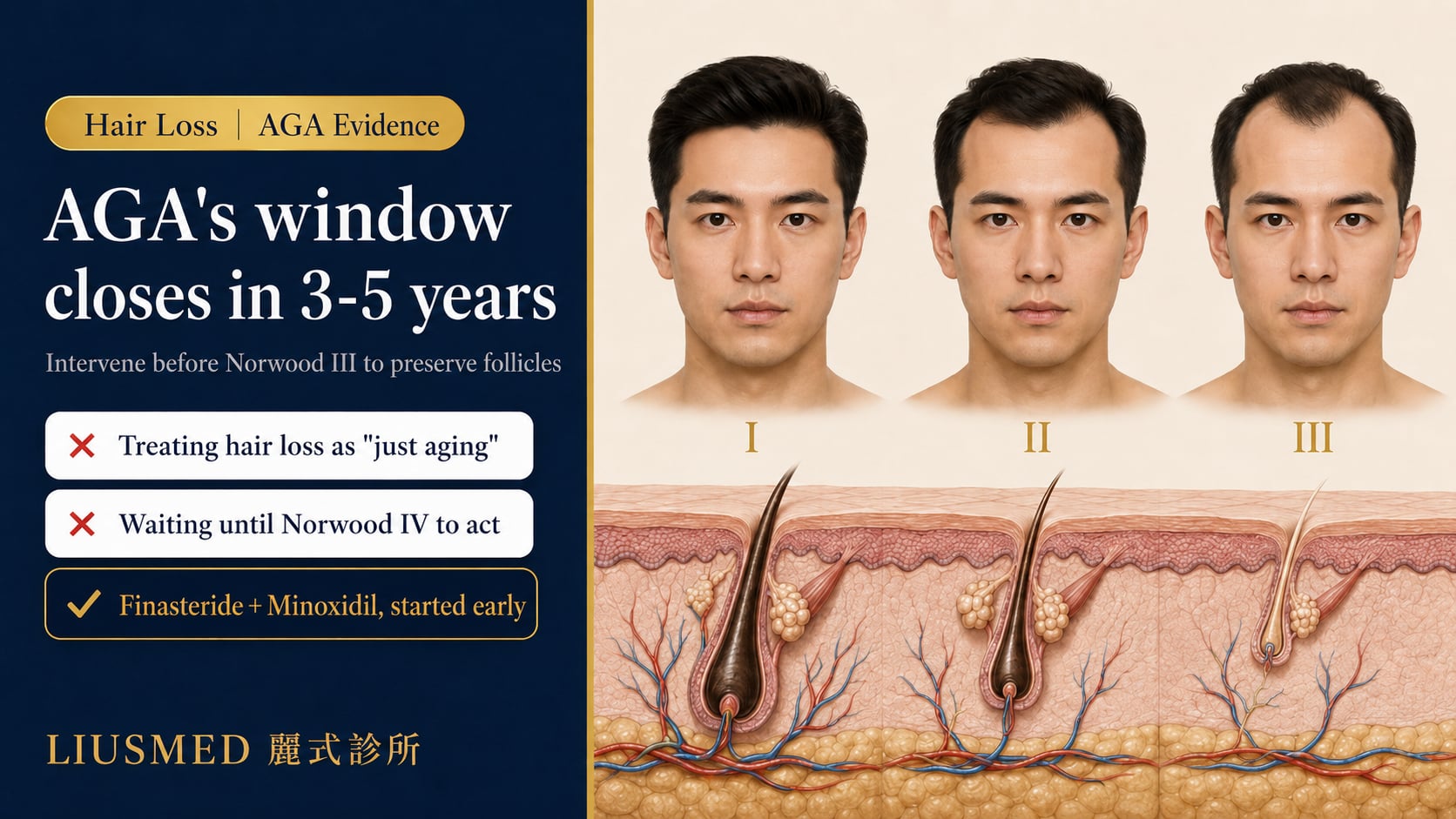
Male AGA Early Intervention: Norwood Staging & Timing
The earlier you intervene in male androgenetic alopecia (AGA), the more follicles you preserve. This article uses the Norwood scale as the f
Want to learn more?
Schedule a consultation for professional evaluation and advice