Facial Asymmetry After Filler: Migration, Uneven Absorption, and How to Correct It
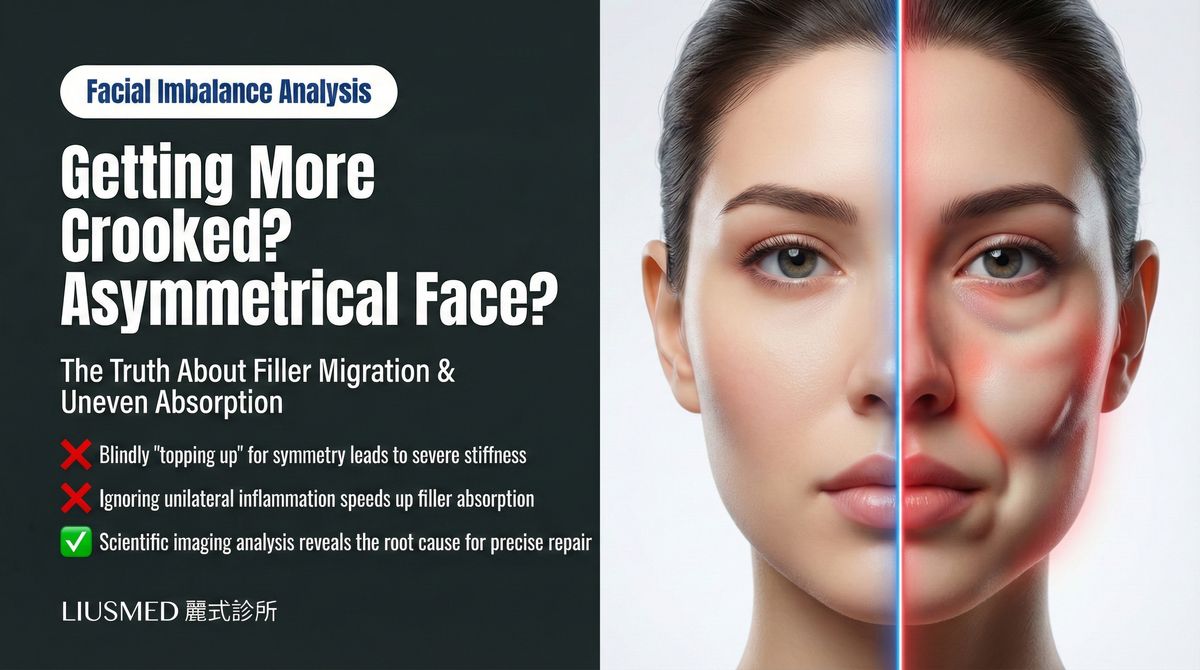
Two Different Sides—The Asymmetry Problem After Filler
You notice something unsettling in the mirror: after filler, the two sides of your face look different. Perhaps one side is fuller, or your smile curves differently on each side. You start taking selfies for comparison, growing more anxious with each photo.
First, accept a fact: the human face is naturally never perfectly symmetric. Studies show that almost everyone has some mild left-right difference, and that is normal. However, if you notice newly appearing or significantly worsened asymmetry after filler injection, the cause is worth investigating.
Four Main Causes of Post-Filler Asymmetry
Cause 1: Uneven Injection Volume or Placement
Even experienced physicians find it extremely difficult to inject identical volumes at identical depths on both sides. Minor differences may be imperceptible initially but become apparent as swelling resolves.
Cause 2: Filler Migration
Fillers migrate due to gravity, muscle movement, and tissue pressure. Because facial muscle activity patterns differ between sides (you may habitually chew on one side), migration direction and magnitude may also differ.
Cause 3: Differential Absorption Rates
| Factor Affecting Absorption | How It Causes Asymmetry |
|---|---|
| Local blood circulation differences | The side with greater blood flow metabolizes filler faster |
| Muscle activity differences | The more active side (habitual chewing side) absorbs faster |
| Tissue structure differences | Varying subcutaneous fat thickness affects filler stability |
| Subtle injection depth differences | Different tissue depths have different metabolic rates |
Cause 4: Pre-Existing Asymmetry Amplified
Filler may amplify facial asymmetry that already existed but was not obvious. Without adequate baseline assessment, identical injection strategies on both sides may make the difference more visible.
Key Insight: The cause of asymmetry determines the correction strategy. Blindly "adding more to the lesser side" or "dissolving from the fuller side" may be temporary cosmesis rather than a fundamental solution. You need to understand the cause first.
Ultrasound for Precise Diagnosis
Bilateral comparative ultrasound scanning provides:
- Residual filler volume comparison: Which side has absorbed more
- Filler position comparison: Whether one side has migrated
- Tissue structure comparison: Whether subcutaneous fat and fascial planes differ
- Encapsulation comparison: Whether one side has fibrous capsule and the other does not
Key Insight: Bilateral ultrasound comparison is the foundation for a precise correction plan. Without this information, any correction attempt is guesswork.
Correction Strategies
Strategy 1: Unilateral Reduction — For asymmetry from excess or migrated filler on one side. HA (Hyaluronic Acid — sugar molecule naturally in skin, holds water): ultrasound-guided hyaluronidase. Non-HA: ultrasound-guided pinhole extraction.
Strategy 2: Unilateral Augmentation — For asymmetry from faster absorption on one side. Prerequisite: the other side is in a satisfactory state.
Strategy 3: Bilateral Adjustment — When both sides have different issues (e.g., migration on one side + absorption on the other).
Strategy 4: Re-sculpt the whole contour — When asymmetry is severe or both sides have multiple issues. This does not have to mean removing every bit of filler. How much comes out is decided by the overall curve and proportions: the excess or migrated portion is addressed along the natural lines, and what remains is smoothed. Hyaluronic acid can usually be dissolved first, with at least about a week before reassessing any top-up; for non-HA filler that needs removal, reassessment for re-injection happens about 3 months later once swelling has settled, not on the day of removal.
Prevention
- Pre-injection standardized photos: Document baseline symmetry
- Assess existing asymmetry: The two sides may need different strategies
- Gradual small-volume injection: Allows fine-tuning at follow-up
- Post-injection monitoring: Regular evaluation of filler status
Common questions
Is asymmetry after filler a sign my injector did a poor job?
Not necessarily. Even experienced physicians find it very hard to inject the exact same volume and depth on both sides, and early swelling often hides small differences until it settles. On top of that, filler can shift over time with gravity and muscle movement, and the two sides may absorb it at different rates. None of that is fully controllable at the moment of injection, so the useful first step is finding out which cause is behind your asymmetry rather than assigning blame.
It has only been a few days and the two sides look different. Should I get it fixed right away?
Not yet. Asymmetry in the first 2 weeks is usually uneven swelling, and it often becomes much less noticeable once the swelling settles. Wait until the 2-week mark; if the difference is still obvious then, come back for an assessment. The exception is skin turning pale or purple, or severe pain: do not wait, seek care immediately.
My face was already a little uneven before filler—do I still need to do anything?
Most people's faces are naturally not perfectly symmetric, and that's normal. What's worth looking into is asymmetry that newly appeared or clearly worsened after your filler. If that's the case, it makes sense to investigate the cause. If it's just a mild difference you already had, chasing perfectly identical sides isn't realistic.
Can filler correct asymmetry I was born with?
It can be assessed, but first we look at where the asymmetry comes from: the bone structure, the soft tissue (fat and skin), or the muscles. Soft-tissue differences are the ones filler can soften best. When the difference is in the bone itself, filler can only partly disguise it and cannot change the shape of the bone. Muscle-driven asymmetry, such as one chewing muscle being larger than the other, calls for a different approach. At the consultation we sort out the cause by examination and ultrasound before discussing whether filler suits you.
How do you tell which cause is behind my asymmetry?
It's hard to tell by eye or from selfies, because migration, faster absorption, and uneven volume can all look similar. We use bilateral comparative ultrasound to see how much filler remains on each side, whether one side has shifted, and whether one side is wrapped in a fibrous capsule. Seeing the actual cause keeps the correction from being guesswork.
Do I have to dissolve all the filler and start over?
Not usually—it depends on the cause. If one side simply has too much or has migrated, that side can be reduced; if one side absorbed faster, a small amount can be added there; if both sides have issues, each is handled separately. Removing everything and re-injecting after the tissue recovers is reserved for cases where the asymmetry is severe or both sides have multiple problems.
Can asymmetry be reduced before it happens?
A few things help. Standardized photos before injection record your starting point, and having the injector assess your existing differences matters because the two sides may need different approaches. Injecting gradually in small amounts leaves room to fine-tune at follow-up, and monitoring the filler over time helps too. None of this makes both sides identical, but it lowers the gap.
My lip, chin, or cheek looks uneven after filler—which article should I read next?
The causes above apply to every area, but what to do next differs by site. For an uneven lip, see lip filler bubbles and nodules and lip filler removal and reshaping. For an uneven chin or jawline, see jawline filler that shifted or turned lumpy and chin and jawline filler removal guided by ultrasound. For uneven cheeks, see migrated cheek filler removal with ultrasound and why cheek filler can look heavier or sag. Whatever the site, the first step is the same: find out where the filler is now, which bilateral ultrasound comparison shows.
Pursuing Perfect Symmetry? Understand Reality First
Perfect facial symmetry essentially does not exist in nature. Pursuing "perfectly identical sides" is not only unrealistic—over-correction may make the face look less natural.
A reasonable goal is: achieving natural, harmonious balance on your natural facial framework that you feel comfortable with.
If post-filler asymmetry concerns you, schedule a consultation. Let us perform bilateral ultrasound comparison to identify the true cause, then develop a precise correction plan.
Related Reading
- Why Do Fillers Migrate? The Science of Displacement
- The Complete Filler Repair Evaluation Process
- Nose Filler Shifted—Treating Deviation and Bridge Widening
Related Services

Specialties
Credentials
- Kaohsiung Medical University, School of Medicine
- Attending Physician, Dermatology, Kaohsiung Chang Gung Memorial Hospital
- Attending Physician, Aesthetic Center, Kaohsiung Chang Gung Memorial Hospital
- Visiting Physician, Dermatology, Xiamen Chang Gung Hospital
- Visiting Physician, Aesthetic Center, Xiamen Chang Gung Hospital
"For every surgery, I strive to achieve a good outcome through a small incision and refined technique. Minimally invasive surgery is not just a technique — it's a commitment of respect to every patient."
Related Articles

Is a Cannula Safer? Weighing Blunt Cannula Against Sharp Needle for Vascular Occlusion Risk
Cannulas lower occlusion risk by an order of magnitude, but lower is not gone. What large-sample data and a cannula occlusion case report ac

Collagen Stimulator Nodules: They All Feel the Same, But Ultrasound Shows Four Different Things
Firm lump after a collagen stimulator? Your fingers cannot tell what it is. The four things ultrasound shows, and which ones should not wait
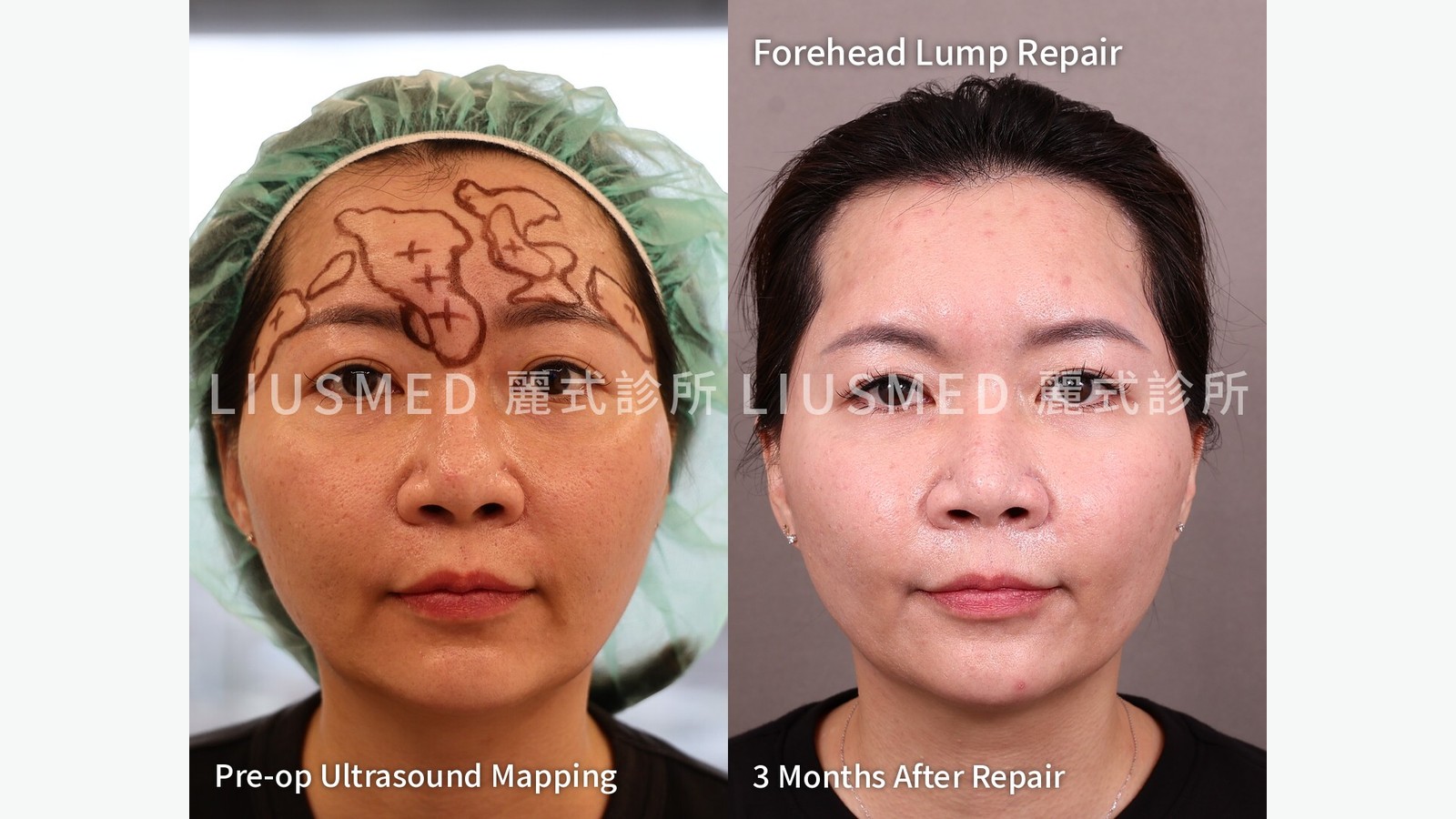
Two Years of Ellansé Forehead Lumps: From Ultrasound Map to Three Months After Repair
Ellansé in the forehead had hardened into stone-like lumps for two years. Hyaluronidase did nothing and a saline flush could not wash it out
Recovery after any procedure needs peer support too


Want to learn more?
Schedule a consultation for professional evaluation and advice