Two Years of Ellansé Forehead Lumps: From Ultrasound Map to Three Months After Repair
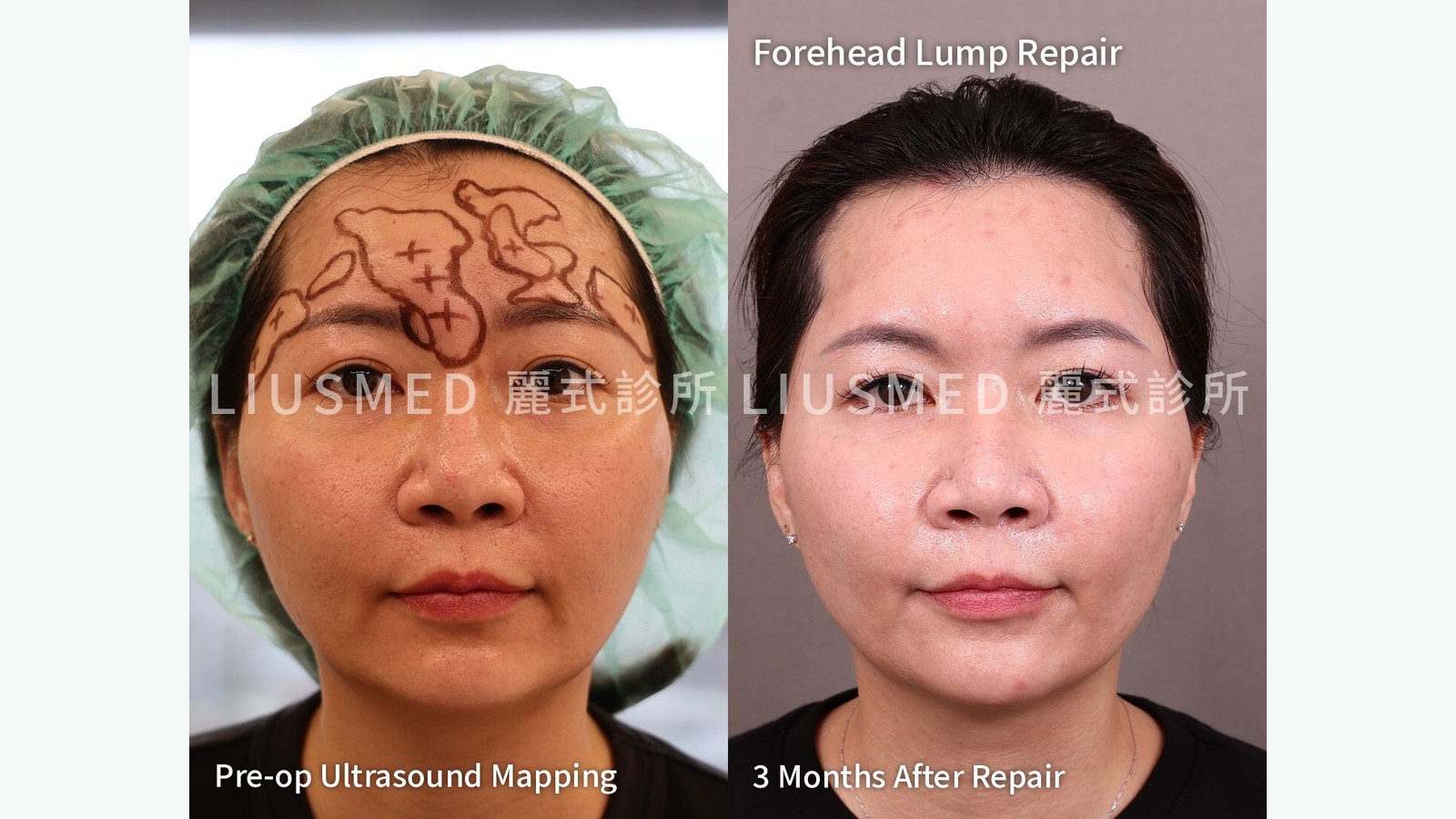
Three months ago, on our forehead and temple filler lump removal page, we published a photo of a patient's forehead covered in outlined shapes. That was her lump map.
We stopped there at the time. We also told her story on our community board: "So... I'll have five scars on my face?". This is the follow-up: the same person, photographed in the same setting, three months after repair.
Two years of lumps, after hyaluronidase and a flush
Her forehead had been injected with Ellansé, a polycaprolactone (PCL) collagen stimulator. It had hardened into lumps two years earlier. They felt like stone, and the surface was badly uneven.
She had not simply waited those two years out.
Hyaluronidase was the first thing tried, but it only acts on hyaluronic acid. Ellansé is made of PCL microspheres, a collagen stimulator, so hyaluronidase has nothing to act on.
A saline flush was tried too. Flushing can be worth discussing early on, while the material is still a gel and has not yet been fixed in place by tissue. A lump that has been wrapped in collagen for two years does not move with water.
Why Ellansé forms lumps in the forehead, and which injection patterns make that more likely, is a question of material and cause. Our filler revision site covers it in full: forehead and temple filler irregularities and lumps. This article is about treatment.
Why the forehead needs a map first
Forehead skin is thin and sits directly on bone, with very little tissue in between to soften anything. Any unevenness here shows up straight away as a visible step on the surface.
Collagen stimulators provoke a strong tissue response and are often wrapped, layer by layer, in a fibrous capsule. The real risk in lump removal is rarely the size of the lump. It is starting to dissect and dig without knowing where it sits. In the forehead, one cut too many or one piece left behind is written on the surface for everyone to see.
So the first step is ultrasound, not a blade. I scanned the whole forehead, confirmed the extent, depth and distribution of each lump one at a time, and drew them back onto the skin.
The lines on the left were not sketched freehand. Each one marks something ultrasound had confirmed. With that map in place, the route in was planned, and the lumps themselves were removed through pinhole-sized openings.
One thing is worth being clear about. What was reduced was the filler itself and the lumps it had caused. Nothing was added to raise the hollows around them so the difference would look smaller.
Why post-treatment photos wait three months
With lump repair, the thing most likely to mislead is timing.
Photograph a forehead right after a saline flush and it looks flat. Photograph it two or three days later and it often still looks flat. It looks like it worked.
Part of that flatness is water. The fluid that was flushed in, and the swelling that follows treatment, temporarily fill in the irregularities, and the lumps are simply covered over. With lumps already encased in collagen, the unevenness usually comes back within a week of that fluid being absorbed.
A lot of people assume at that point that the lumps have grown back. They never left.
The same applies after surgical removal. Freshly treated tissue is swollen, and photos taken then look good, but they are not the result yet. Only once the swelling has settled, the fluid has been absorbed and the tissue has stabilized does what remains show the real outcome.
That is why the post-treatment photos I use to judge a result are taken at three months. Every comparison in this article is from the three-month visit.
Three months after repair
Front view:
The view from above is the one I most want people to see. With light falling across the curve of the forehead, no irregularity has anywhere to hide:
At 45 degrees you see the contour from above the brow up into the forehead. Before, that line broke into separate bumps. At three months it reads as a more continuous curve:
In profile you see the forehead outline itself. On a forehead, bumps along that outline are the lumps:
This is how this one patient recovered. Appearance after removal, how quickly swelling settles and how well the skin re-drapes all vary from person to person, depending on how much was injected, how long it has been there and the condition of the skin.
Not every lump can be removed completely
I say this in every consultation.
Collagen stimulator lumps become entangled with the surrounding tissue, and after two years even more so. Some areas come out cleanly. In others, to avoid damaging healthy tissue, there is a trade-off between taking a little more and leaving the surface smooth.
The goal was to bring the surface back to smooth, so the forehead returns to a more natural line and she no longer has to explain to people what is on her face. It was never to clear every last microsphere.
Her repair is not finished
The forehead was the first stage.
Beyond the forehead, this patient also has areas in her apple cheeks and nasolabial folds that need attention, planned as later, separate stages. Each area differs in the state of the material, its depth and what removal involves, so it was not all done at once. We will document the later stages as well. For how those areas are approached, see apple cheek filler revision and nasolabial filler revision.
Photos are used with the patient's consent and show the same patient before treatment and three months after repair. This is an individual case and does not represent results for everyone. All five angles are also in our case gallery.
This case also has a page on our filler revision site, focused on why hyaluronidase and flushing did not work and when to stop and assess first: the forehead Ellansé case.
Common questions
Does hyaluronidase work on Ellansé lumps?
No. Hyaluronidase only acts on hyaluronic acid. Ellansé is made of PCL microspheres, a collagen stimulator, so it does not respond. This is why the material should be confirmed before treatment, rather than injecting first and seeing what happens.
Can a saline flush wash Ellansé out?
It depends on timing. Early on, while the material is still a gel and has not been fixed by tissue, flushing can be worth discussing. With lumps that have been encased in collagen for a long time, the water temporarily props the irregularities up, and once it is absorbed the unevenness usually returns soon after.
How long after removal can the result be judged?
Smoothness right after treatment comes partly from swelling and tissue fluid. We judge the result at three months, when the swelling has gone down and the tissue is more stable. Actual recovery time varies by case.
Will removal leave a noticeable scar on the forehead?
We work through pinhole-sized openings. In this patient, at three months, the pinhole sites are not noticeable. How scars show depends on individual skin, location and aftercare, and varies from person to person.
Ellansé has been there for two years. Can it still come out?
Older lumps sit in tighter tissue and call for more care during removal, but they do not disappear just because time has passed. Whether removal is suitable, and how much can be taken out, depends on first seeing the position, depth and extent on ultrasound and then assessing the individual case.
If your forehead has lumps like these
If you have lumps in your forehead or temples that you can feel and see, and hyaluronidase or flushing has not helped, an ultrasound assessment is a sensible first step. Seeing what is there, and at which layer, is what makes it possible to talk about what comes next.
You are welcome to describe your situation through our online consultation.
Further reading
- Ellansé Lumps: What to Do When You Feel a Hard Nodule
- Can Ellansé Be Removed? Collagen Stimulator Extraction
- Bumps and Waves on the Forehead After Filler—Migration, Superficial Placement, or Both?
- Fat Grafted Under the Eye Turned Into a Lump, Then a Stimulator Was Added to Hide It: A Full Record of Removing Five-Year Stacked Nodules
About the author
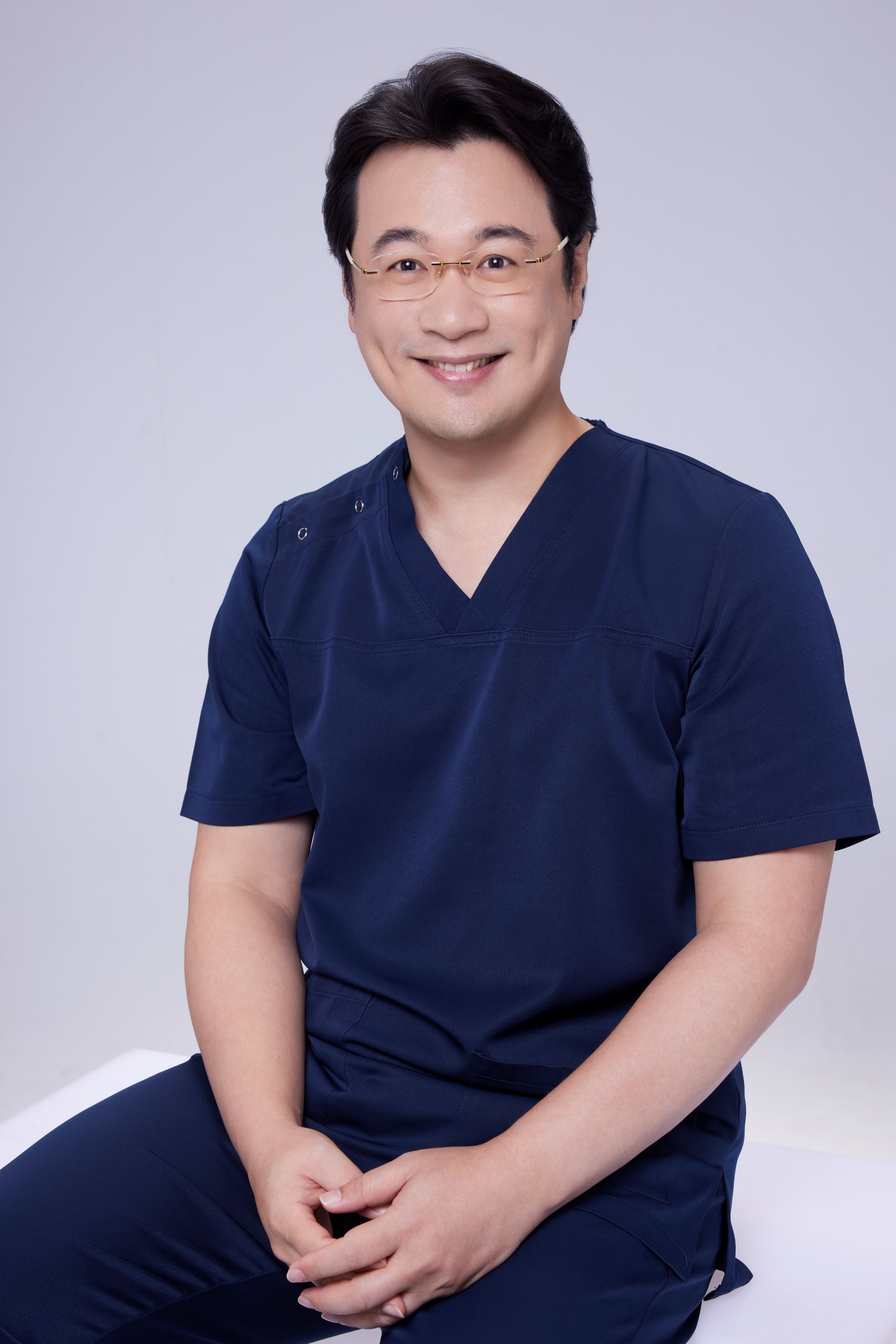
Dr. Ta-Ju Liu is the director of Liusmed Clinic. His work focuses on ultrasound-guided repair of filler complications, on the principle that you have to see it to handle it safely.
Related services
Specialties
Credentials
- Kaohsiung Medical University, School of Medicine
- Attending Physician, Dermatology, Kaohsiung Chang Gung Memorial Hospital
- Attending Physician, Aesthetic Center, Kaohsiung Chang Gung Memorial Hospital
- Visiting Physician, Dermatology, Xiamen Chang Gung Hospital
- Visiting Physician, Aesthetic Center, Xiamen Chang Gung Hospital
"For every surgery, I strive to achieve a good outcome through a small incision and refined technique. Minimally invasive surgery is not just a technique — it's a commitment of respect to every patient."
Recovery after any procedure needs peer support too

Want to learn more?
Schedule a consultation for professional evaluation and advice